Quick Answer: An owner’s draw is money a business owner takes out for personal use. It is not a paycheck, not an expense, and never deductible. You do not pay tax on the draw itself — you pay income tax and self-employment tax on your business’s full profit, whether you draw it or not.
You took money out of your business all year. Now your tax bill is based on money you never touched — including profit still sitting in the business bank account.
If that feels wrong, you are missing one idea: the owner’s draw. This guide explains what a draw is, who can take one, and how the tax really works, with real numbers instead of just rules.
What Is an Owner Draw?
An owner’s draw is money — or something of value — that a business owner takes out of the business for personal use.
It is not a paycheck. There is no pay stub, no tax withheld, and no W-2 at year end. It is not a business expense either, so the business can never deduct it.
A draw is simply how sole proprietors, single-member LLC owners, and partners pay themselves. You may also see it written as owner’s draw or owners draw — all three names mean the same thing.
What Counts as a Draw?
Anything of value you take out for yourself, including:
- Cash you transfer from the business account to your personal account
- Personal bills you pay from the business account or a business card
- Business assets — a vehicle, equipment — that you start using personally
Every one of these counts, even when no cash moved. Record them all as draws. Paying personal costs straight from the business account without recording them (commingling) makes your books messy, and it blurs the line between you and your LLC — the very line that gives an LLC its protection.
Is an Owner Draw Taxable?
Not directly. The draw itself is not taxed (one exception: a partner who draws more than their basis — covered below) — your profit is.
When you take a draw, nothing is withheld and the amount is not reported as income anywhere. Instead, the IRS taxes your business’s full net profit for the year on your personal return, whether that money left the business or stayed in the bank.
On top of income tax, pass-through owners pay self-employment tax on the same profit. The rate is 15.3%: a 12.4% Social Security part on earnings up to the 2026 wage base of $184,500, plus a 2.9% Medicare part with no cap at all. The tax is worked out on 92.35% of your net earnings. Our guide to the Medicare tax rate shows how the two parts of that 15.3% differ. Every legitimate expense you claim lowers that profit first — our guide to what a tax write-off is shows how much each deduction actually saves.
Because nothing is withheld from a draw, you settle the bill yourself through quarterly estimated tax payments. Our Payroll & Self-Employment Tax guide walks through how self-employment tax and estimated payments fit together.
How do quarterly estimated taxes work with an owner draw?
The IRS wants its share as you earn, not next April. Owners who take draws usually pay estimated tax four times a year on Form 1040-ES, due April 15, June 15, September 15 and January 15.
In the $90,000 example in this guide, the self-employment tax alone is $12,717 — that is about $3,179 a quarter, before income tax. Setting aside a fixed share of every draw (many owners use 25–30% of profit (a common rule of thumb, not an IRS rule)) in a separate account is the simplest way to have the money ready.
You can usually avoid the underpayment penalty if one of these fits you:
- The tax you still owe after withholding and credits is under $1,000.
- You paid at least 90% of this year’s tax during the year.
- You paid at least 100% of last year’s tax (110% if your income was over $150,000).
You only need to meet one — whichever target is smallest for you.
The $90,000 Test: Same Profit, Same Tax
Here is the rule, proven with one example.
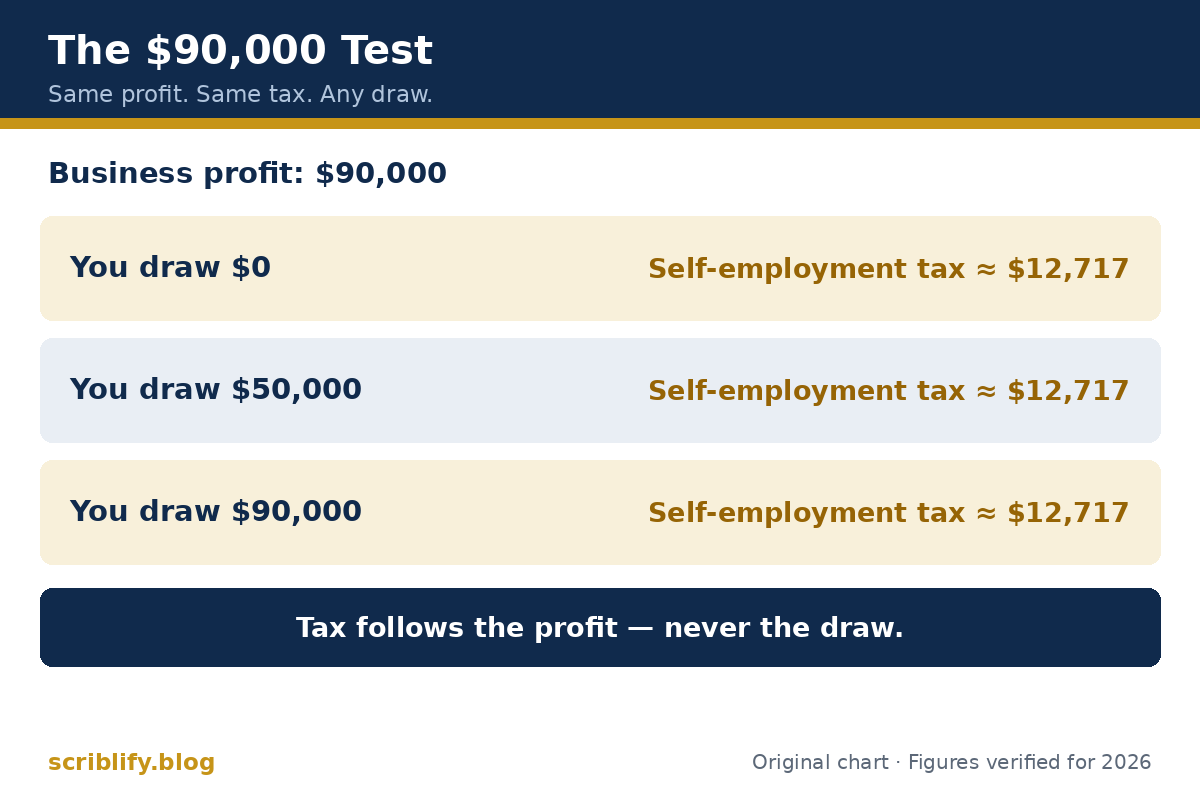
Say your business makes $90,000 of net profit this year. Self-employment tax is 15.3% × 92.35% × $90,000 ≈ $12,717. Now watch what happens to that number as the draw changes:
| What you draw | Your profit | Self-employment tax |
|---|---|---|
| $0 — leave it all in the business | $90,000 | ≈ $12,717 |
| $50,000 | $90,000 | ≈ $12,717 |
| $90,000 — take it all | $90,000 | ≈ $12,717 |
This example assumes you have no W-2 job on the side and no extra 0.9% Additional Medicare Tax — either one changes the total.
The tax never moves, because it was never based on the draw. Income tax works the same way: it is calculated on the $90,000 profit, not on the amount you transferred to yourself.
Split into quarterly estimated payments, that self-employment tax alone is about $3,179 per quarter — the amount many owners forget to set aside, because nobody withheld it for them.
How Does an Owner Draw Work for Each Business Type?
It depends entirely on your business structure — and corporations cannot use draws at all. Still deciding how your business should be taxed? Our guide on the difference between an LLC and a corporation compares the tax, cost, and paperwork of each side by side.
| Business type | How owners take money out | Deductible by the business? | Tax withheld when paid? | What you pay tax on |
|---|---|---|---|---|
| Sole proprietor | Owner’s draw | No | No | All of your Schedule C profit |
| Single-member LLC (default) | Owner’s draw | No | No | All profit, on your personal return |
| Partnership / multi-member LLC (default) | Draws (cash distributions) | No | No | Your share of the profit (Schedule K-1) |
| S corporation | Salary first, then distributions | Salary: yes · Distributions: no | Yes — on the salary | Salary + your share of the profit (Schedule K-1) |
| C corporation | Salary, then dividends | Salary: yes · Dividends: no | Yes — on the salary | Salary + dividends |
Sole Proprietors and Single-Member LLCs
You and the business are the same taxpayer, so a draw is the only way to take money out. You cannot put yourself on payroll, and you cannot deduct a salary or a withdrawal. The draw is only one side of owning an LLC — the benefits of an LLC, from liability protection to pass-through taxation, are covered in our full guide.
A single-member LLC is a “disregarded entity” (an LLC the IRS ignores for tax purposes — the owner reports everything) by default, so the IRS treats it exactly like a sole proprietorship: the profit lands on your return (generally Schedule C (the form sole proprietors use to report business profit)), and it is taxed in full whether you draw it or not. Most owners taking draws run a single-member LLC — a disregarded entity for tax purposes, which is why the profit is taxed to you personally.
Partners and Multi-Member LLCs
Partners are self-employed, not employees. The business must not issue you a W-2 — not for draws, and not for guaranteed payments either. Guaranteed payments (set payments for a partner’s services) are different from draws: the partnership can deduct them, and the partner counts them as income subject to self-employment tax.
You pay tax on your share of the profit, shown on Schedule K-1 (the form that reports each partner’s share of profit) — not on the cash you withdraw. One trap: cash draws are normally tax-free, but if you draw more than your basis (roughly, the stake you have built up from contributions and already-taxed profits), the excess is taxed as a gain.
S Corporations and C Corporations
There are no owner draws here. If you work in your S corporation, you are an employee: the IRS requires a reasonable salary through payroll, with withholding and a W-2. Profit above that salary comes out as distributions — not wages, and not deductible by the business.
A C corporation also pays its owner-employees a salary. Leftover profit then reaches you as dividends, which the corporation cannot deduct — that is the double tax corporations are known for. The IRS Paying Yourself page sets out these rules for each structure.
Owner Draw vs Salary: What Is the Difference?
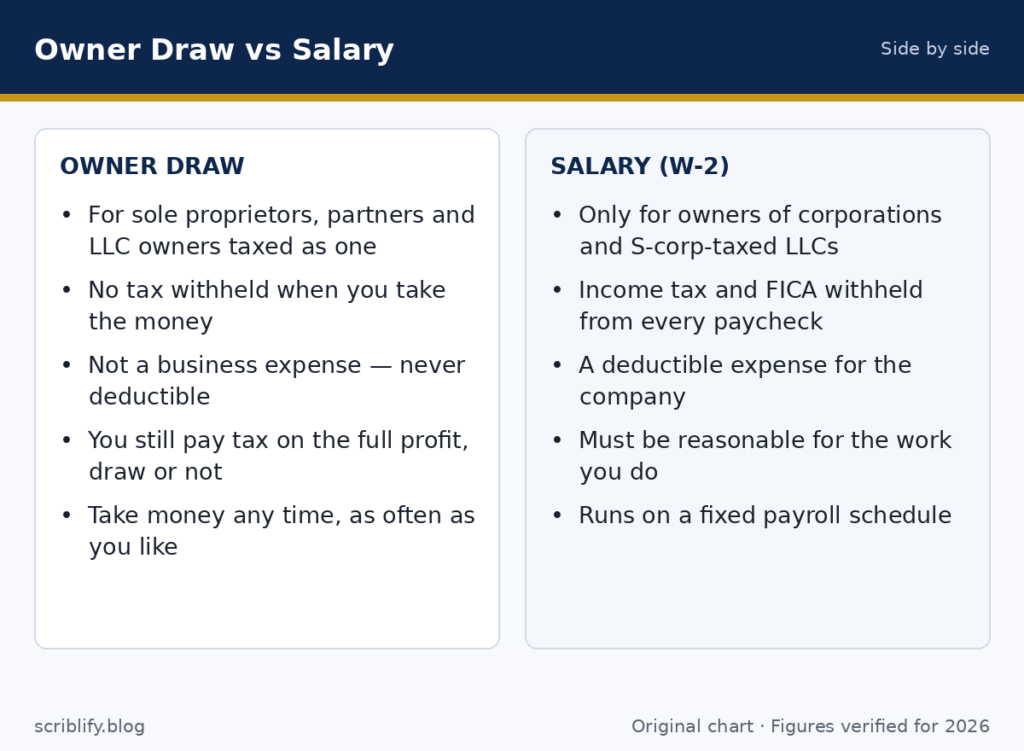
A salary is taxed at the moment it is paid. A draw is taxed through your profit, whenever you happen to take it.
- Who can use it: Salaries are for corporation owners and employees. Draws are for sole proprietors, partners, and owners of default LLCs.
- Withholding: A salary has income tax and payroll tax withheld from every paycheck. A draw has nothing withheld.
- Deduction: A salary is a deductible business cost. A draw is never deductible.
- Paperwork: A salary means payroll and a W-2. A draw means a bank transfer and one bookkeeping entry.
- What gets taxed: A salary is taxed as wages. A draw is not taxed at all — the profit behind it is.
A draw also builds no W-2 wages — and retirement-plan contributions are based on wages or self-employment earnings, not on draws.
How Do You Take an Owner’s Draw and Record It?
Take it as a clean bank transfer, and book it to an equity account — never as an expense.
- Move the money. Transfer it from the business bank account to your personal account, or write yourself a check. Keep the two accounts separate.
- Use the right account. In your bookkeeping software, use an equity account named “Owner’s Draw.” QuickBooks and similar tools include one, or let you add it under equity.
- Record the entry. Debit Owner’s Draw, credit Cash. In plain words: your draw balance goes up, the bank balance goes down.
- Close it at year end. The draw account is emptied into your capital (ownership) account, so it starts fresh in January.
For every draw, note the date, the amount, and a short memo (for example, ‘owner draw’) — that habit is your proof if the IRS ever asks.
On your balance sheet, draws sit in the equity section and reduce your ownership stake. They never appear on the profit and loss statement, and they never touch Schedule C — which is why a healthy-looking P&L can sit next to an empty bank account.
A quick equity example: you put $40,000 of your own money into the business, your share of the year’s profit is $90,000, and you draw $50,000 during the year. Your owner equity at year end is $40,000 + $90,000 − $50,000 = $80,000. The draw lowered your equity — it never touched the profit figure itself.
Our bookkeeping basics guide shows how these entries fit into your monthly books.
How Often Can I Take a Draw?
As often as you like. The IRS sets no limit on the number or timing of draws — weekly, monthly, quarterly, or whenever the business can spare the cash. If your operating agreement or partnership agreement sets rules, those rules are the limit.
Start With What You Need
- Your personal living costs for the period.
- Any slow months you expect.
- Big business bills coming up — inventory, insurance, tax payments.
- For partners: what is fair between the owners.
How Much Should You Draw? The Safe-Draw Formula
Only draw what is left after the tax reserve and the running costs are covered.
Safe draw = profit − tax reserve − operating buffer.
Worked on the $90,000 example: set aside the ≈ $12,717 of self-employment tax first, plus a reserve for the income tax you will owe on the same profit. Then keep a buffer for running costs — if the business spends about $4,000 a month, keeping one to two months ($4,000–$8,000) in the account is a sensible floor. Whatever remains after that is genuinely yours to draw.
Partners have one extra limit: drawing beyond your basis can trigger tax, as explained above. Check your basis before taking a large draw.
What Are the Most Common Owner Draw Mistakes?
Most draw problems come from five avoidable mistakes.
- Deducting the draw. A draw is never deductible. Booking it as an expense makes your books wrong and your tax return wrong.
- Believing tax follows the draw. Drawing nothing does not make the tax zero, and drawing everything does not raise it. Owners who believe this under-save all year and get one large April bill.
- Taking a W-2 as a partner. Partners are not employees of their partnership. W-2 wages are for corporation owners and staff only.
- Skipping the S-corp salary. Taking only distributions to dodge payroll tax is exactly what the reasonable-compensation rule exists to stop.
- Mixing money. Paying personal costs from the business account and never recording them as draws — messy books now, hard questions later.
Key Takeaways
- An owner’s draw is how sole proprietors, partners, and default LLC owners take money out. It is not a paycheck and not an expense.
- A draw is never deductible, and nothing is withheld when you take one.
- You are taxed on your full business profit, not on what you draw: on $90,000 of profit, self-employment tax is ≈ $12,717 at any draw amount.
- Corporations do not use draws — S corporations pay salary plus distributions; C corporations pay salary plus dividends.
- Record every draw in an equity account, and cover your tax reserve before you draw.
A draw is only one route. To compare every way an LLC owner can take pay — draws, distributions, guaranteed payments, salary and dividends — see our guide on how to pay yourself from an LLC.
FAQs
Do I pay taxes on an owner’s draw?
No — the draw itself is not taxed. You pay income tax and self-employment tax on your business’s full profit for the year, whether you draw that profit out or leave every dollar in the business bank account. Most owners cover the bill with quarterly estimated tax payments.
Is an owner’s draw a business expense?
No. An owner’s draw is not an expense, and it is never deductible. It does not appear on your profit and loss statement or on Schedule C. In your books it sits in an equity account, because you are taking out your own ownership stake, not paying a business cost.
What is the difference between an owner’s draw and a salary?
A salary is wages: the business deducts it, tax is withheld from each paycheck, and the worker gets a W-2. A draw is the opposite: no deduction, no withholding, no W-2. Only corporations pay owner salaries. Sole proprietors, partners and default LLC owners use draws instead.
Can an LLC owner take a salary?
Only if the LLC elects corporate tax status. A default single-member LLC owner takes draws, like a sole proprietor. If the LLC elects S corporation status, the owner becomes an employee and must take a reasonable salary by payroll. That election changes the whole pay method, not just the name.
How do I record an owner’s draw in QuickBooks?
Create or use the equity account named Owner’s Draw, then record the transfer from your business bank account into that account — never as an expense. In QuickBooks Online, categorize the bank transfer to Owner’s Draw under equity. At year end, the draw account closes into your capital account.
Why doesn’t my owner’s draw show on my profit and loss statement?
Because a draw is not income or an expense — it is you withdrawing your own equity. Profit and loss statements only track revenue and business costs, so draws correctly stay off it. You will find them on the balance sheet, inside the equity section, reducing your ownership stake.
Why did I owe tax when I barely paid myself?
Because the IRS taxes the profit your business earned, not the cash you took out. If your business made $90,000 and you drew only $20,000, the full $90,000 is still taxed, including self-employment tax of about $12,717. Quarterly estimated payments stop this April surprise.
Should S-corp owners take a salary or distributions?
Both, in that order. An S corporation owner who works in the business must first take a reasonable salary through payroll, with withholding and a W-2. Only profit above that salary comes out as distributions. Skipping the salary and taking only distributions is the mistake the IRS looks for.
Is an owner’s draw the same as a distribution?
They are the same basic idea — the owner taking business profit out — with different names depending on the entity. Sole proprietors and partners take draws. LLC members take draws or distributions. In a corporation, money paid out to shareholders is called a distribution or a dividend, and S corp owners must take a salary before distributions. The label follows the entity, not the money.
Is an owner’s draw considered income?
No. A draw is you taking out profit that is already yours. You are taxed on the business’s profit for the year — not on the draw itself.
Are owner’s draws taxed twice?
No. The profit is taxed once, on your personal return, in the year the business earns it. Taking the money out later does not tax it again. (Corporations are different: their profits are taxed at the company, and dividends can be taxed again.)
Conclusion
An owner’s draw looks simple: take money out, spend it. The part that trips owners up is invisible — the tax follows the profit, not the transfer. Plan around that: reserve for tax first, record every draw in equity, and let corporations use payroll instead of draws. Do those three things, and paying yourself stops producing April surprises.
If you are weighing an S corporation election or setting up payroll, our Payroll & Self-Employment Tax guide walks through the salary side step by step. And if your structure or numbers are getting complex, a short review with a CPA usually costs less than one year of estimated-tax mistakes.
This guide is educational and is not tax advice.
Leave a Reply