Quick Answer: A disregarded entity is a one-owner business — usually a single-member LLC — that the IRS treats as not separate from its owner for federal income tax. The status is automatic: you file nothing to get it. The LLC files no return of its own; you report the profit on your personal return and pay tax on it yourself.
You probably met this term on a form. A client sent you a W-9 to fill in. Or your state paperwork described your brand-new LLC as “disregarded,” and it sounded like something was wrong.
Nothing is wrong. Disregarded is the normal tax setting for a one-owner LLC in the United States. This guide covers what it means in practice: how you are taxed, when you need an EIN, how to fill in that W-9, and the points where “disregarded” stops applying.
What does “disregarded entity” actually mean?
It means the IRS treats you and your business as the same taxpayer for federal income tax. In the words of Treasury Regulation §301.7701-2(c)(2)(i), the entity is “disregarded as an entity separate from its owner.”
Two limits matter here:
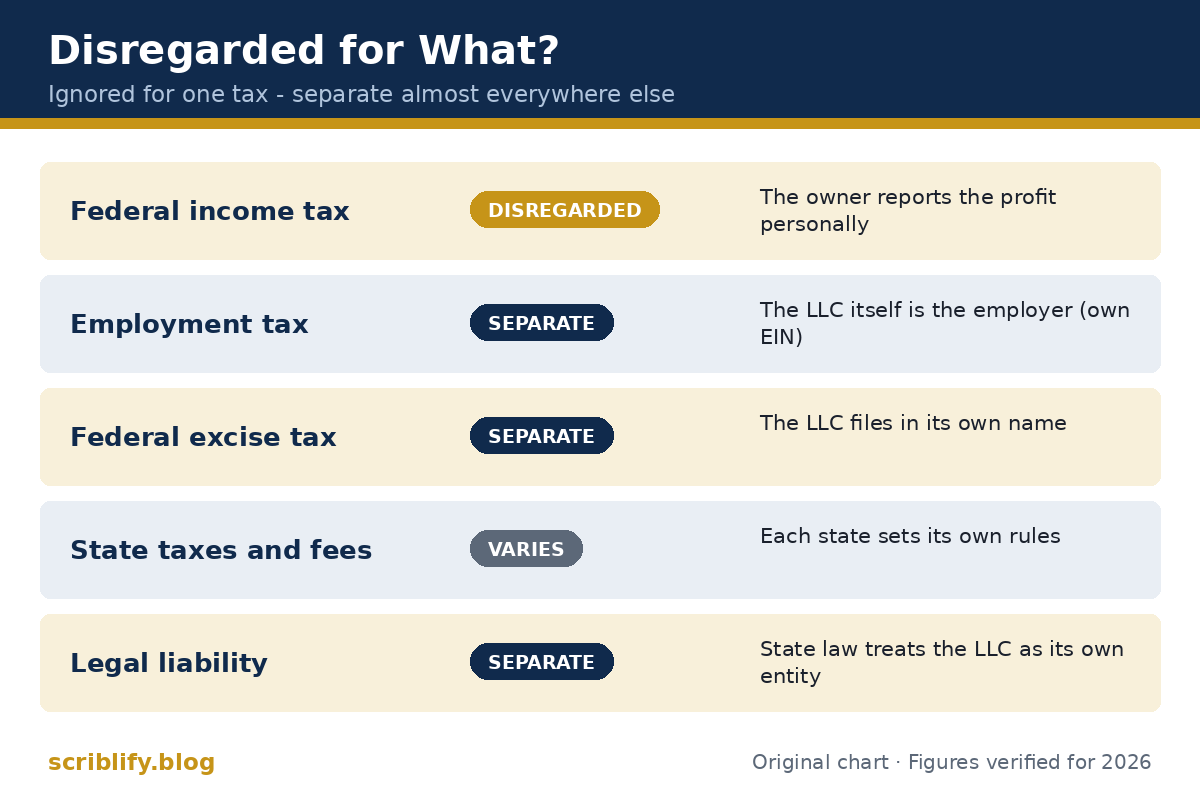
- It is only about federal income tax. The classification says nothing about payroll taxes, excise taxes, state taxes, or your legal liability.
- Your LLC is still real under state law. You formed it with your state, and state law treats it as a separate entity that can own property, sign contracts, and stand between your business and your personal assets.
Myth check: “Disregarded means I pay no tax.” Wrong — and this is the most costly misunderstanding with this status. Disregarded means the LLC pays no separate tax, because you pay all of it yourself, on your own return, including self-employment tax. The tax does not disappear. It just lands on you personally.
Am I One?
You are probably a disregarded entity if all three fit: (1) you are the only owner of your LLC; (2) you never filed Form 8832 or Form 2553 to change how it is taxed; (3) the IRS has never treated your LLC as a corporation or partnership. If all three fit, the IRS ignores your LLC for income tax — you and the business are one taxpayer.
Is my LLC a disregarded entity?
Yes, if you are the only owner and you have not elected corporate taxation. Under the default rule in Regulation §301.7701-3(b)(1), a one-owner LLC is disregarded automatically unless it elects to be taxed as a corporation.
You file nothing to get this status. There is no form, no application, and no approval letter. It applies from the day your single-member LLC exists.
A few other situations count too:
- An LLC owned by a corporation or partnership can also be disregarded. Its income and expenses are simply reported as a division of the owning company.
- A qualified subchapter S subsidiary (QSub) and a grantor trust are disregarded as well — the single-member LLC is just the most common case.
- Married couples in community property states get a special option. Under Rev. Proc. 2002-69, spouses who are the only two members can choose to treat their LLC as a disregarded entity instead of a partnership.
For the wider picture of how LLCs are taxed, see our complete LLC taxes guide for small business owners.
How is a disregarded entity taxed?
On your personal return. The LLC files no federal income tax return of its own, and every dollar of profit flows to you.
In practice, that means:
- Business profit goes on your Form 1040 — typically Schedule C, or Schedule E or F, depending on the activity.
- You pay regular income tax on the profit at your own tax rates.
- You also pay self-employment tax: 15.3% on 92.35% of your net earnings, the same way a sole proprietor does. Half of that self-employment tax is deductible on your return.
A worked example: $90,000 of profit
Say your single-member LLC makes $90,000 of profit in a year. Here is the self-employment tax alone: (Your self-employment tax is worked out on Schedule SE.)
| Step | Math | Result |
|---|---|---|
| Earnings counted for SE tax | $90,000 × 92.35% | $83,115 |
| Self-employment tax | $83,115 × 15.3% | $12,717 |
| Deductible half | $12,717 ÷ 2 | ≈ $6,359 |
On top of the $12,717, you owe ordinary income tax on the profit at your personal rates. That is the real cost of “disregarded” — the business files nothing, but the owner pays twice over: income tax plus self-employment tax.
Because there is no separate business return, there is no separate business tax bill either — you pay the tax yourself. You pay your tax in quarterly estimates on Form 1040-ES, in your own name — and you do not need a separate EIN to make those payments. The money itself reaches you through an owner’s draw — our guide explains how draws work and why the tax follows the profit, not the draw.
Where does “disregarded” stop?
Disregarded applies to federal income tax only. In four areas, your LLC is treated as very much separate.
Employment taxes: the LLC is the employer
For employment taxes, a single-member LLC is treated as a separate entity — this has been the rule for wages paid on or after January 1, 2009 (Treasury Decision 9356). The moment you hire, the LLC steps out from behind you.
First-hire steps for a disregarded LLC:
- Get an EIN in the LLC’s own name.
- Register as an employer.
- Withhold payroll taxes from wages and make the required tax deposits.
- File Form 941 each quarter and Form 940 each year — under the LLC’s name and EIN.
- Issue W-2s to your employees under the LLC’s name and EIN.
Our payroll and self-employment tax guide explains those filings in full.
Excise taxes: separate since 2008
Certain federal excise taxes also treat the LLC as a separate entity, for periods from January 1, 2008. These are filed on forms such as 720, 730, 2290 and 11-C, and some activities need a Form 637 registration. For most small businesses, the realistic case is Form 2290 — the heavy highway vehicle use tax that hits trucking businesses.
State taxes: every state decides for itself
“Disregarded” is a federal income-tax label. States run their own rules, and many charge the LLC directly:
| State | What applies to a single-member LLC |
|---|---|
| California | $800 annual tax, and the LLC files Form 568 |
| Delaware | Flat $400 annual LLC tax, due June 1 |
| Texas | A franchise tax report each year |
| Tennessee | State franchise and excise taxes can apply |
| New York City | The unincorporated business tax can apply |
| Many other states | They simply follow the federal classification |
State rules change often — treat this table as examples, and check your own state’s current rules.
Liability: not disregarded at all
Nothing about this tax label weakens your LLC’s legal separation. Under state law the LLC remains its own entity — that separation is the whole reason you formed it.
Do I need an EIN for a disregarded entity?
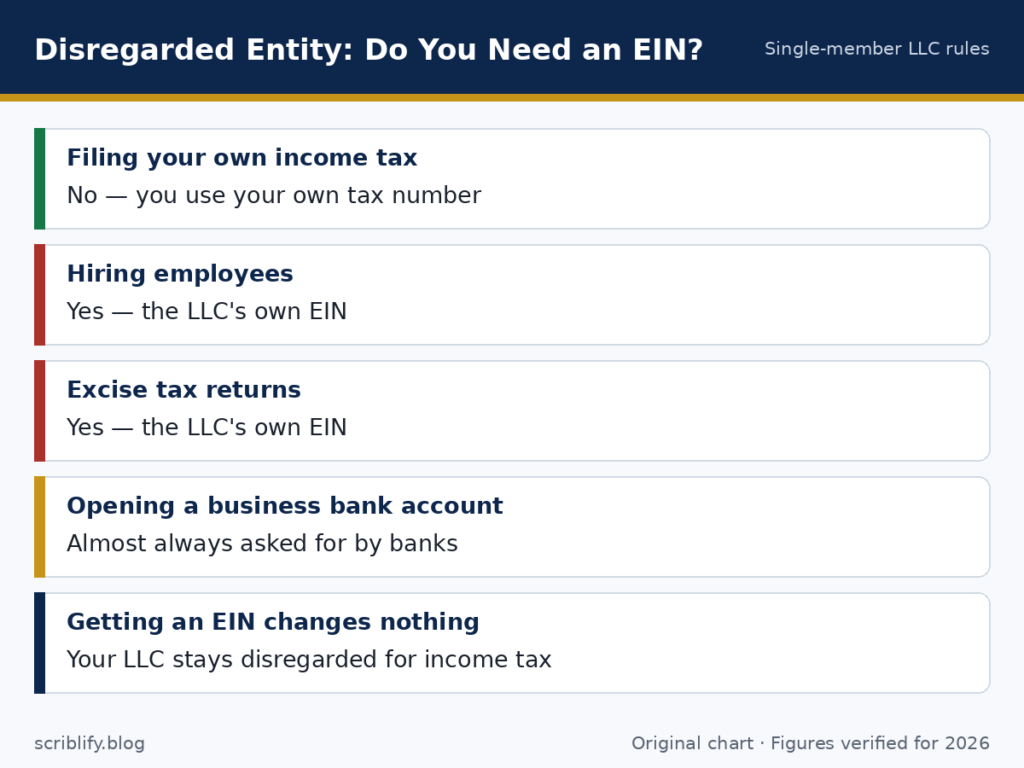
Not for income tax. If your LLC has no employees and no excise-tax liability, the IRS says it does not need an EIN at all.
The rules work like this:
- For all information returns, including a W-9, the LLC generally uses the owner’s Social Security number or EIN — not the LLC’s EIN.
- You do need the LLC’s own EIN once you hire employees or file excise-tax returns, because those filings are made in the LLC’s name.
- Many banks ask for an EIN to open a business account. That is a practical preference, not a legal requirement.
- Getting an EIN does not end the disregarded status. An EIN is just an ID number; your tax classification stays the same.
How do I fill in a W-9 as a disregarded entity?
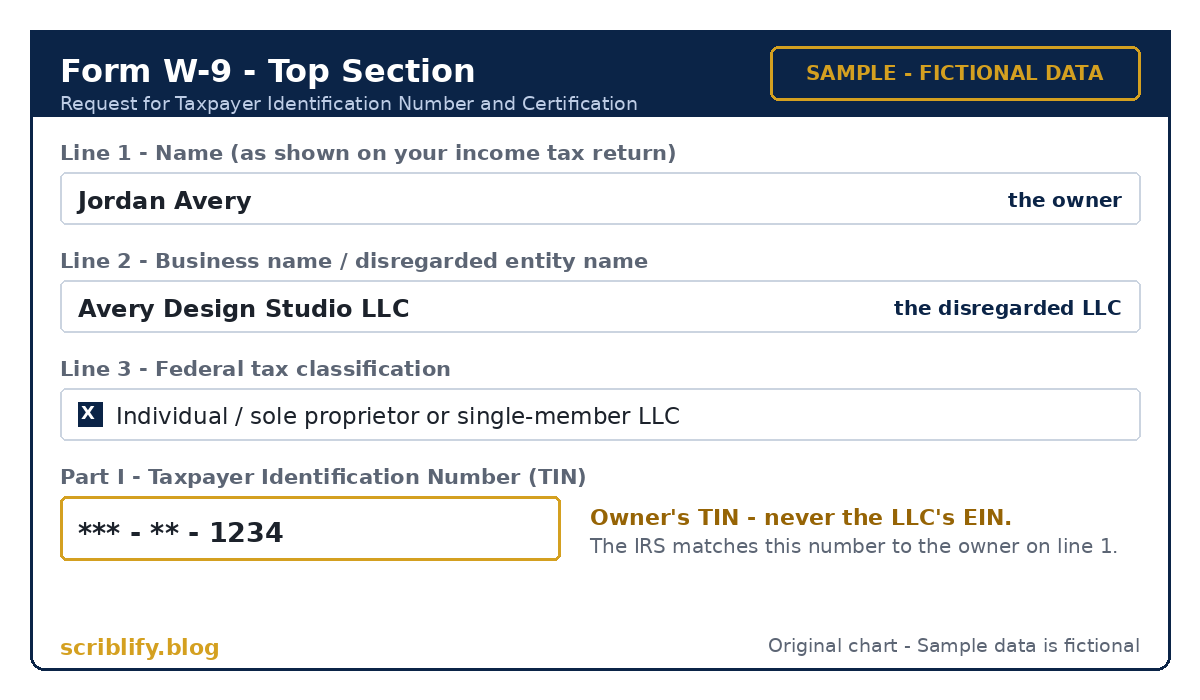
Put yourself on line 1, your LLC on line 2, and your own tax ID number in Part I — never the LLC’s EIN. This is the most common disregarded-entity mistake, and it is the one clients’ accounting departments trip over.
The IRS instructions break down as follows:
- Line 1: Your full legal name as the owner — the individual, not the business.
- Line 2: Your LLC’s name.
- Part I (TIN): Your own Social Security number, or your own EIN if you have one as the owner.
Why it matters: the name on line 1 and the TIN in Part I must match in IRS records. If a client gets a W-9 showing the LLC’s name with the LLC’s EIN, the mismatch can trigger an IRS notice (a B-notice) and hold up your payment. The sample below shows the correct layout. The same look-through rule covers 1099s: payments to your disregarded LLC are reported as payments to you, the owner.
Payers use your W-9 to decide your year-end forms — see our 1099 forms and contractors guide for the full picture.
Disregarded entity vs sole proprietorship: what actually differs?
For taxes, almost nothing. The IRS taxes the owner of a disregarded single-member LLC in the same manner as a sole proprietorship. The real differences are legal and administrative:
| Disregarded single-member LLC | Sole proprietorship | |
|---|---|---|
| Federal income tax | On the owner’s return | On the owner’s return |
| Self-employment tax | 15.3% on 92.35% of profit | 15.3% on 92.35% of profit |
| Legal separation | Separate entity under state law | None — you and the business are one |
| State filings and fees | Formation plus possible annual tax or reports | No LLC filings or annual LLC tax |
If you are weighing an LLC against incorporating instead, our guide on the difference between an LLC and a corporation walks through the tax, cost and paperwork comparison in detail.
What are the advantages and disadvantages of a disregarded entity?
The status is the default, not a choice most owners shop for — but it helps to see both sides clearly.
Advantages
- One tax return: your business result rides on your own Form 1040 — no separate business return to file.
- No payroll for yourself: you take draws, with no withholding or W-2 for the owner.
- Simple to start and run: the status is automatic, with no election form to file.
Disadvantages
- You pay self-employment tax on the full profit — there is no salary-and-distributions split to lower it.
- Lenders and investors may take a one-owner LLC less seriously than a corporation.
- Adding one member ends the status at once, and the business becomes a partnership for tax.
How does an LLC stop being disregarded?
Three things end the status — one happens by accident, two are deliberate elections.
1. You add a second owner. The change is automatic, and there is no form to file for the change itself. From that day, the LLC is taxed as a partnership: it files Form 1065 every year, sends each member a Schedule K-1, and late filing is penalized per partner, per month.
2. You elect C corporation taxation (Form 8832). Filing Form 8832 tells the IRS to tax the LLC as a C corporation, with its own corporate return.
3. You elect S corporation taxation (Form 2553). Form 2553 is only for electing S status — an LLC going back to disregarded files Form 8832, not 2553. Note also that after an LLC elects corporate treatment, it generally has to wait 60 months before it can change classification again, and switching back can be treated as a liquidation. Talk to a CPA before making — or reversing — either election.
Foreign owners, one warning. If the owner is not a US person, a disregarded single-member LLC still has a yearly filing: a pro-forma Form 1120 with Form 5472 attached. The penalty for missing Form 5472 is $25,000, which makes it the one disregarded-entity filing you cannot afford to skip. If the forms are still missing 90 days after the IRS writes to you, another $25,000 is added for every 30 days the failure continues.
Key Takeaways
- A disregarded entity is a one-owner business the IRS ignores as separate from its owner — for federal income tax only.
- The status is the default for a single-member LLC. You file nothing to get it.
- Disregarded never means tax-free: the owner reports the profit personally and pays income tax plus 15.3% self-employment tax on 92.35% of earnings.
- The LLC stays separate for employment taxes, excise taxes, state taxes and legal liability.
- A no-employee LLC does not need an EIN, and on a W-9 you always use your own name and TIN — never the LLC’s EIN.
- Adding a second owner ends the status automatically and turns the LLC into a partnership for tax purposes.
If you run a disregarded single-member LLC, you pay yourself by draw — never by payroll. Our guide on how to pay yourself from an LLC compares all five pay methods on one $120,000 example.
Frequently Asked Questions
Does a disregarded entity file its own tax return?
No. A disregarded single-member LLC does not file a separate federal income tax return. The owner reports all income and expenses on their own return — usually Schedule C for a business. The LLC may still file other returns, such as payroll returns if it has employees, under its own name and EIN.
Does a disregarded entity pay taxes?
Yes. “Disregarded” never means tax-free. The LLC itself files no income tax return, but the owner pays income tax on all the profit personally, plus 15.3% self-employment tax on 92.35% of net earnings. On $90,000 of profit, that self-employment tax alone comes to about $12,717.
Is a disregarded entity the same as a sole proprietorship?
For federal income tax, almost. The IRS taxes the owner of a disregarded single-member LLC in the same manner as a sole proprietorship, with the same schedules and self-employment tax. Legally they differ: the LLC is a separate entity under state law, so it can shield your personal assets and has state filings a sole proprietor skips.
Can a disregarded entity have employees?
Yes. Since 2009 the LLC is treated as a separate entity for employment taxes, even though it stays disregarded for income tax. It needs its own EIN, withholds and deposits payroll taxes, files Forms 941 and 940, and issues W-2s — all in the LLC’s name, using the LLC’s EIN, not the owner’s.
Does a disregarded entity need an EIN?
Not always. A single-member LLC with no employees and no excise-tax liability does not need an EIN, according to the IRS — the owner uses their own SSN or EIN. You do need the LLC’s EIN once you hire employees or file excise returns, and many banks ask for one to open a business account.
Can a two-member LLC be a disregarded entity?
Generally no. An LLC with two or more members is taxed as a partnership by default, filing Form 1065 and issuing K-1s. One exception: in community property states, a married couple who are the only members can choose to treat their LLC as a disregarded entity under Rev. Proc. 2002-69.
What happens if I add a member to my single-member LLC?
The change is automatic — there is no form to file for the change itself. From that point the LLC is taxed as a partnership: it files Form 1065 each year, sends every member a Schedule K-1, and late filing is penalized per partner, per month. The disregarded status simply ends the day the second owner joins.
What is the $600 rule for 1099s?
It was the old payment amount that triggered a 1099 form. For payments made in 2026, the main threshold is $2,000, not $600 — the $600 figure in older guides is out of date.
How do I know if my LLC is a disregarded entity?
Check two things. If you are the only member of your LLC, and you never filed Form 8832 or Form 2553 to choose corporate tax, your LLC is disregarded automatically — no application and no approval needed. The moment a second member joins, or you file one of those election forms, the status changes.
Conclusion
A disregarded entity is not a loophole and not a problem — it is simply the IRS treating your one-owner LLC as you. You get the legal separation of an LLC with the simple tax filing of a sole proprietor.
Just respect the boundaries: your own name and TIN on paperwork, the LLC’s own EIN the moment you hire, and your state’s own taxes on top.
If you are adding a member, hiring your first employee, or thinking about an S corporation election, an hour with a CPA before you file anything is money well spent. And for the full picture of how LLCs are taxed, start with our complete LLC taxes guide.
This guide is educational and is not tax advice.
Leave a Reply