Quick Answer
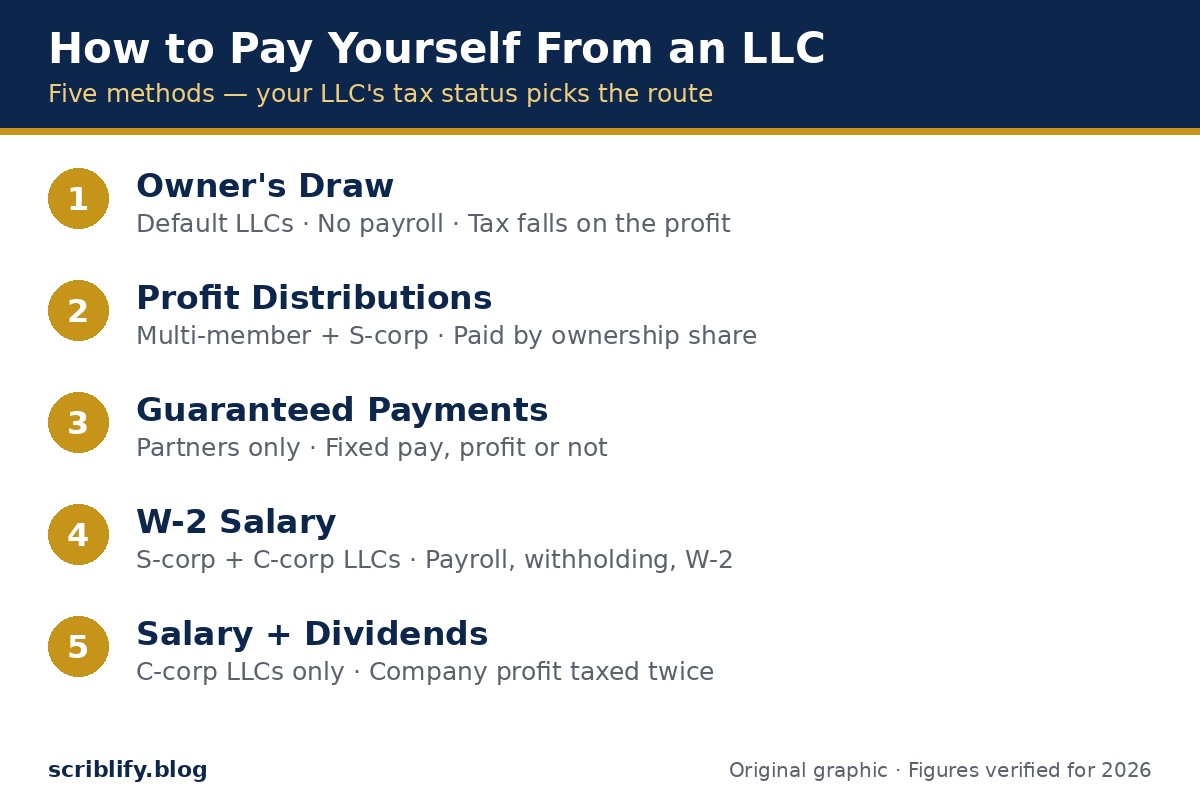
How to pay yourself from an LLC depends on how your LLC is taxed. Single-member and partnership-taxed LLCs pay owners with draws or guaranteed payments — never a W-2. If your LLC elects S-corp or C-corp tax status, you become an employee and take a salary through payroll, plus distributions or dividends on top.
The IRS does not tax “an LLC” — it taxes yours in one of four ways, and each has its own pay rules. Pick the wrong method and you create real problems: a W-2 you were never allowed to issue, or a salary so low the IRS steps in. This guide routes you to your method first, then runs all five methods on one profit figure.
Which Pay Method Can You Use? Find Your Route
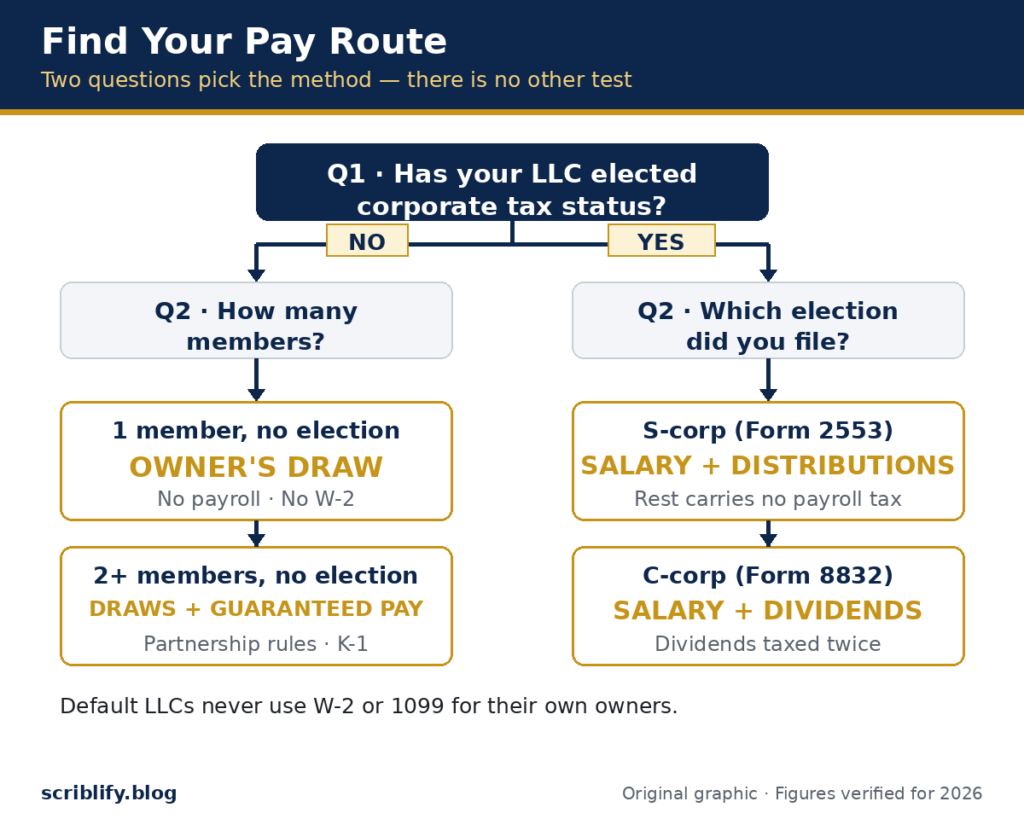
Two questions decide it: how many members does your LLC have, and how is it taxed?
Route 1 — Single-member LLC, no election. You are a disregarded entity by default. You pay yourself with an owner’s draw. No payroll, no W-2.
Route 2 — Multi-member LLC, no election. You are taxed as a partnership. Each member takes draws, and a member who works in the business can also receive guaranteed payments.
Route 3 — LLC taxed as an S corporation (Form 2553). You are an employee of your own LLC: a reasonable salary through payroll, with the rest as distributions.
Route 4 — LLC taxed as a C corporation (Form 8832). Also an employee: salary through payroll, and company profit can later be paid as dividends.
One warning for Routes 1 and 2: you cannot put yourself on payroll, and you can never issue yourself a 1099 from your own LLC. Some guides list “pay yourself as a contractor” as an option — it is not one. The IRS guide on paying yourself is clear: partners are not employees.
One Profit, Five Ways to Take It: The $120,000 Example
Rules are hard to feel, so here is one LLC with $120,000 of net profit, paid out five ways. The figures are illustrative, but every number is computed the way the IRS computes it.
Way 1 — Draw (default, single-member). Self-employment tax falls on 92.35% of profit: 92.35% × $120,000 = $110,820. At 15.3%, the tax is about $16,955 (roughly $13,742 Social Security + $3,214 Medicare). You may draw up to the full $120,000 — the draw itself is not taxed and not a business expense. The tax falls on the profit, drawn or not.
Way 2 — Guaranteed payment (multi-member). Guaranteed payments sit on top of profit shares, so they get their own worked example below: a fixed $2,500 a month for the managing partner, paid in good months and bad.
Way 3 — S-corp salary + distributions. Payroll on a reasonable salary of $70,000 carries FICA of $10,710 (15.3%). The employer’s half — $5,355 — is a deductible business expense. What is left, $120,000 − $70,000 − $5,355 = $44,645, comes out as distributions: income tax still applies, but no payroll or self-employment tax. Employment-tax saving versus the draw route: about $6,245 — before payroll-service fees and admin, which eat into it.
Way 4 — C-corp salary + dividends. Same $70,000 salary, same $10,710 FICA, same $44,645 left — but now it is company profit. Corporation tax at 21% takes $9,375. The remaining $35,270, paid to you as a dividend, is taxed again: at an example 15%, that is $5,290. (Qualified dividends are taxed at 0%, 15% or 20% depending on income — 15% here is just an example.) Combined tax on that $44,645 slice: about $14,665. That is the double tax, in plain numbers.
Way 5 — Distributions. Your share of profit paid out — by ownership percentage in a partnership-taxed LLC, or the post-salary remainder in an S-corp (Way 3). Income tax is settled through your profit share; the payout adds no second tax — unless an S-corp owner takes out more than their stock basis.
All Five Methods, Side by Side
| Method | Who can use it | Deductible for the LLC? | Withholding? | Taxed to whom, on what | Reported on | How often |
|---|---|---|---|---|---|---|
| Owner’s draw | Sole proprietors, single-member LLCs, partners | No | No | Owner, on full net profit | Schedule C or K-1 | Any time |
| Distribution | Multi-member LLCs, S-corps | No | No | Owner, on their share of profit | Schedule K-1 | Per operating agreement |
| Guaranteed payment | Partners in a partnership-taxed LLC only | Yes — Form 1065, line 10 | No | Partner: ordinary income + SE tax for services | K-1, then Schedule E | Fixed schedule in the agreement |
| Salary (W-2) | Owners of LLCs taxed as S-corp or C-corp | Yes — wages + employer payroll tax | Yes — income tax + FICA | Owner, as wages | Form W-2 | Regular paydays |
| Dividend | Owners of LLCs taxed as C-corp only | No | No | Owner, at dividend rates (0/15/20%) | Form 1099-DIV | When declared |
Method 1: Owner’s Draw — The Short Version
A draw is the simplest method of all: you move money from the business account to your personal account. There is no pay stub, no withholding and no W-2, because for tax purposes you and the business are the same person (single-member), or you are a partner (multi-member).
The point most new owners miss: your tax is worked out on the LLC’s full net profit, not on how much you drew. Draw nothing and you still owe it; draw everything and the tax is the same. For the full picture — how draws are taxed, recorded and sized — read our guide: What Is an Owner Draw? How It Works and How It’s Taxed. Whatever route you use, record each payment in your books as an owner’s draw — our owner draw guide shows exactly how to record it.
Method 2: Profit Distributions — Your Share, Paid Out
A distribution is a payment of profit based on ownership. Own 60% of a multi-member LLC and you are entitled to 60% of distributed profit, unless your operating agreement says otherwise.
In a partnership-taxed LLC, distributions are tracked through each member’s capital account and arrive on your Schedule K-1, taxed as part of your profit share. In an S-corp they come after salary and carry no payroll tax — exactly why the IRS insists the salary comes first and is reasonable. Two cautions: never distribute cash the business needs for tax bills and suppliers; and S-corp owners who exceed their stock basis can trigger extra tax, so check your basis first.
Method 3: Guaranteed Payments — A Fixed Wage Without Payroll
What is a guaranteed payment?
A guaranteed payment is a fixed amount a partnership-taxed LLC pays a partner for services (or for the use of their capital), set without regard to the partnership’s income. “Guaranteed” means the partner is paid whether the LLC has a good year or a bad one.
Only multi-member LLCs taxed as partnerships can use it. Single-member owners cannot, and neither can S-corp or C-corp owners.
How does a guaranteed payment work in practice?
Say a two-member LLC agrees that one partner will manage the business day to day. The operating agreement promises her $2,500 a month — $30,000 a year — for that work, in profitable months and slow months alike.
The tax treatment, per IRS Publication 541:
- The LLC deducts the $30,000 on Form 1065, line 10.
- There is no income-tax withholding, and it is not a W-2 wage — partners are never employees of their own partnership.
- The partner reports it on Schedule K-1, then on Schedule E of her own return as ordinary income, separately from her profit share.
- Because it pays for services, she also pays self-employment tax on it.
Guaranteed payments suit an LLC where one partner works in the business and the other is a silent investor: the working partner gets steady pay, and both still share what is left by ownership. Agree the amount and schedule and write it into the operating agreement — unwritten, it invites arguments later.
Method 4: W-2 Salary — For S-Corp and C-Corp Owners
With a corporate election, the picture flips: you are an employee of your own company, paid a salary through real payroll — income tax and FICA withheld, pay stubs, and a W-2 at year end.
What counts as a “reasonable” salary?
The IRS rule is one sentence: pay yourself what a similar business would pay someone else to do your job. There is no fixed percentage in any IRS rule — anyone quoting you a set split is selling a myth.
To land on a defensible number, work through: What would hiring a non-owner to do your job cost locally? How many roles do you cover — manager, salesperson, bookkeeper? How many hours do you work? What do job ads show for the same work? How much of the profit comes from your personal work versus staff or equipment?
Write down how you reached the figure and keep it in the records. Set salary too low to dodge payroll tax and the IRS can reclassify distributions as wages, with back taxes and penalties. Our Payroll & Self-Employment Tax guide covers the payroll-tax side in full.
How Do You Set Up Payroll for an S-Corp LLC? Step by Step
- Get an EIN for the LLC if it lacks one — payroll accounts are tied to it.
- Register with your state for withholding and unemployment insurance accounts.
- Choose how to run payroll — most small S-corps use a payroll provider to calculate withholding, file forms and issue W-2s.
- Set your salary using the factors above, and put the reasoning in writing.
- Pick a pay schedule — monthly is common for owner-only payrolls — and stick to it.
- Run payroll and deposit the taxes withheld from each paycheck on the IRS deposit schedule.
- File Form 941 each quarter to report wages and withholding (very small employers may qualify for the annual Form 944).
- At year end: issue yourself a W-2, file W-3 with the Social Security Administration, and file Form 1120-S, which issues your Schedule K-1 for the remaining profit.
Switching from draws to payroll? Stop draws the day payroll starts, keep the methods in separate records, and note the switch date for your accountant.
Method 5: C-Corp Salary + Dividends — Know the Double Tax
A C-corp-taxed LLC pays its owner in two layers. First a salary through payroll, like the S-corp route — deductible, so taxed once, to you.
Second, profit left in the company is taxed at 21%. Paid out later as a dividend, it is taxed again on your return at 0%, 15% or 20%. Way 4 showed the cost: about $14,665 combined on a $44,645 slice. Retaining profit at 21% can suit a business reinvesting heavily, but for most small LLCs paying out profit yearly, this is the most expensive route. Compare it in our guide to the difference between an LLC and a corporation.
How Much — and How Often — Should You Pay Yourself?
No method has an IRS-set amount. What changes is the rhythm:
- Draws: any amount, any time — but leave enough behind for the tax bill and running costs.
- Distributions: when profit and cash flow allow, and only as your operating agreement permits.
- Guaranteed payments: the fixed amount, on the fixed schedule, even in a loss month.
- Salary: a steady amount on regular paydays. Varying it with cash flow undermines your “reasonable salary” position.
- Dividends: only when the company formally declares one from after-tax profit.
And if tax is not being withheld through payroll, expect quarterly instalments on Form 1040-ES — owing $1,000 or more at filing generally means estimated payments were required.
Many owners also set aside roughly 25–30% of profit in a separate account for taxes, as a rule of thumb. It is a saving habit, not an IRS rule — your real percentage depends on your profit and tax bracket.
Mistakes That Trigger IRS Attention
- Issuing yourself a 1099. Never an option, in any structure. Owners are paid by draw, guaranteed payment, salary or dividend — full stop.
- Taking a W-2 as a partner. Partners are not employees; a partnership-taxed LLC “running payroll” for its own members is doing it wrong.
- Skipping the S-corp salary. Taking only distributions to dodge payroll tax is the most-audited pattern in this area.
- Setting salary by a myth. There is no IRS percentage for reasonable pay — use real market evidence for your job.
- Mixing money. Paying personal bills from the business account blurs every method. Transfer pay to yourself first, then spend it.
- Missing the election deadline. Form 2553 has a strict filing deadline — miss it and this year’s pay method is decided for you.
Choosing Your Election: Form 2553 vs Form 8832
Your pay method is really decided by one choice: keep the default tax status, or elect corporate status.
- Stay default for simplicity: draws (plus guaranteed payments for working partners), no payroll, tax on profit through your personal return.
- Elect S-corp (Form 2553) when profit is healthy and steady: salary + distributions can cut employment tax, as the $120,000 example showed — at the cost of payroll admin and a defensible salary.
- Elect C-corp (Form 8832) only with a clear reason, such as retaining profit in the business: salary works well, dividends are taxed twice.
If self-employment tax is starting to sting, this decision is worth one session with a CPA before you file anything — the saving is real, but so are the deadlines.
Key Takeaways
- Your LLC’s tax status — not preference — decides how you get paid: default LLCs use draws and guaranteed payments; corporate-elect LLCs use salary plus distributions or dividends.
- Default owners can never take a W-2 or a 1099 from their own LLC.
- On $120,000 of profit, the draw route’s self-employment tax is about $16,955; an S-corp paying a $70,000 salary pays $10,710 in payroll tax instead — a saving of about $6,245 before admin costs.
- Guaranteed payments give a working partner fixed, deductible pay without payroll — taxed as ordinary income plus self-employment tax.
- A C-corp dividend is taxed twice: about $14,665 combined on the example’s $44,645 slice.
- Reasonable compensation has no IRS percentage. Set it from market evidence for your actual job, and document it.
FAQs
Can I pay myself a W-2 with an LLC?
Only if your LLC has elected to be taxed as an S corporation or a C corporation. In a default LLC — single-member or partnership-taxed — owners are not employees and cannot receive a W-2 from their own business. Default owners pay themselves with draws or guaranteed payments instead.
Should I take a salary or distributions from my LLC?
If you have an S-corp election, the answer is both, in that order: a reasonable salary first, because the IRS requires it, then distributions from what is left. The distributions carry no payroll tax, which is where the saving comes from. Skipping the salary entirely is the pattern that draws IRS attention.
How much can I pay myself from my LLC?
Up to the cash the business can spare — there is no legal cap on draws or distributions. Your tax, though, is based on the profit, not on what you take out. On the salary route, the amount is set by reasonable compensation: what your job would pay if someone else did it.
Can I transfer money from my LLC to my personal account?
Yes — that transfer is exactly how a draw or a distribution works. Move the money from the business account to your personal account, by bank transfer or a check written to yourself, and record it in your books as an owner’s draw or distribution. What you cannot do is pay personal bills straight from the business account. Corporate-taxed LLCs are different: owners there are paid through payroll and formal distributions or dividends, not casual transfers.
What if my LLC makes no money — can I still pay myself?
You can still take a draw if the business account has cash, for example from earlier profits or a loan, but there is no profit to tax. A guaranteed payment is still owed even in a loss year, because it does not depend on income. An S-corp that cannot pay a reasonable salary should be cautious about taking distributions instead.
Do LLC owners get taxed twice?
Not in a default or S-corp-taxed LLC — profit is taxed once, on the owners’ personal returns. Double tax applies only to the C-corp route: the company pays 21% on its profit, and a dividend paid from that profit is taxed again on your personal return at 0%, 15% or 20%.
Can I pay myself from my LLC with a 1099?
No. You can never issue yourself a Form 1099 from your own LLC, in any tax structure. Owners are not their own contractors. Depending on your tax status, you pay yourself with a draw, a guaranteed payment, a W-2 salary, or a dividend — those are the only routes.
What is the most tax-efficient way to pay myself from an LLC?
At lower profits, the default route is usually simplest and cheapest to run: you are taxed on profit once, with no payroll costs. As profit grows, an S-corp election often wins — a reasonable salary plus distributions cut the employment tax, worth about $6,245 on the $120,000 example above, before payroll fees and admin. There is no single winner at every income; run your own profit through both routes before electing anything.
Can I change the way I pay myself from my LLC?
Yes. Inside the default rules you can switch between draws and guaranteed payments by amending your operating agreement. Moving to salary means changing your tax status: file Form 2553 for an S-corp election (mind the deadline — two months and 15 days into the tax year for it to apply that year) or Form 8832 for a C-corp election. Method changes apply going forward, so keep records of when each method started and stopped.
How often should I pay myself from my LLC?
It depends on the method. Draws can be taken any time. Guaranteed payments follow the fixed schedule in your operating agreement. Salary must run on regular paydays, like any employee’s. Dividends are paid only when formally declared. The best schedule is the one your cash flow and tax set-asides can support every month.
Conclusion
So — how do you pay yourself from an LLC? Find your tax status first, and the method picks itself: draws or guaranteed payments under the default rules, salary plus distributions as an S-corp, salary plus dividends as a C-corp. Then run the numbers on your own profit, as the $120,000 example did, before deciding whether an election is worth filing.
Still unsure? Start with our Payroll & Self-Employment Tax guide to see what each method costs — and if an S-corp election is on the table, have a CPA sanity-check your salary figure before the Form 2553 deadline passes.
New to LLC taxes in general? Start with our complete LLC taxes guide for small business owners.
This guide is educational and is not tax advice.
Leave a Reply