Quick answer: The Medicare tax rate for 2026 is 1.45% of your wages, paid by you as the employee, and 1.45% paid by your employer — 2.9% in total. There is no wage cap. High earners pay an extra 0.9% Additional Medicare Tax above set thresholds. The 1.45% rate did not change for 2026.
Introduction
Every US paycheck carries a small line for Medicare tax. Most workers never think about it. Yet it helps fund hospital care for tens of millions of people.
This guide breaks down the 2026 rates in plain words. You will see exactly what leaves your paycheck, what your employer pays, and what changes for high earners.
What Is the Medicare Tax?
The Medicare tax is a payroll tax that funds Medicare hospital insurance, known as Part A. It is one half of FICA, alongside Social Security tax.
Your employer takes it from every paycheck. They match it dollar for dollar. The money helps pay for hospital stays and care for people on Medicare.
Unlike income tax, the rate is flat. Everyone pays the same percentage. There are no brackets and no deductions.
It is separate from the Medicare premiums you may pay after age 65. This is the payroll tax you pay during your working years.
You do not pay Medicare tax on Social Security benefits — the tax applies to wages and self-employment income, not to benefit payments.
What Are the Medicare Tax Rates for 2026?
In 2026, employees pay 1.45%, employers pay 1.45%, and self-employed workers pay 2.9%. Here is the breakdown:
| Who pays | Medicare tax rate |
|---|---|
| Employee | 1.45% of wages |
| Employer | 1.45% of wages |
| Employee + employer combined | 2.9% of wages |
| Self-employed | 2.9% of 92.35% of net earnings |
The rate applies to all wages. Salaries, hourly pay, bonuses, and tips all count. It starts with the first dollar you earn.
There is no minimum either. A teenager’s first summer job pays Medicare tax on every dollar.
Your share comes out of your pay automatically. Your employer’s share is extra. It never reduces your take-home pay.
What Changed for 2026?
Nothing changed in the Medicare tax rate itself. It stays at 1.45% for 2026, exactly as in 2025.
| Item | 2025 | 2026 |
|---|---|---|
| Medicare tax rate (employee) | 1.45% | 1.45% — no change |
| Medicare tax rate (employer) | 1.45% | 1.45% — no change |
| Wage cap on Medicare tax | None | None |
| Social Security wage base | $176,100 | $184,500 |
| Additional Medicare Tax thresholds | Unchanged | Unchanged |
In short: the Medicare rate did not change; what moved is the Social Security cap next to it.
If you earn between $176,100 and $184,500, you now pay Social Security tax on more of your wages than last year. Your Medicare tax works exactly as before.
How Much Comes Out of a Paycheck?
Multiply your gross pay by 1.45%. On a $1,000 paycheck, that is $14.50.
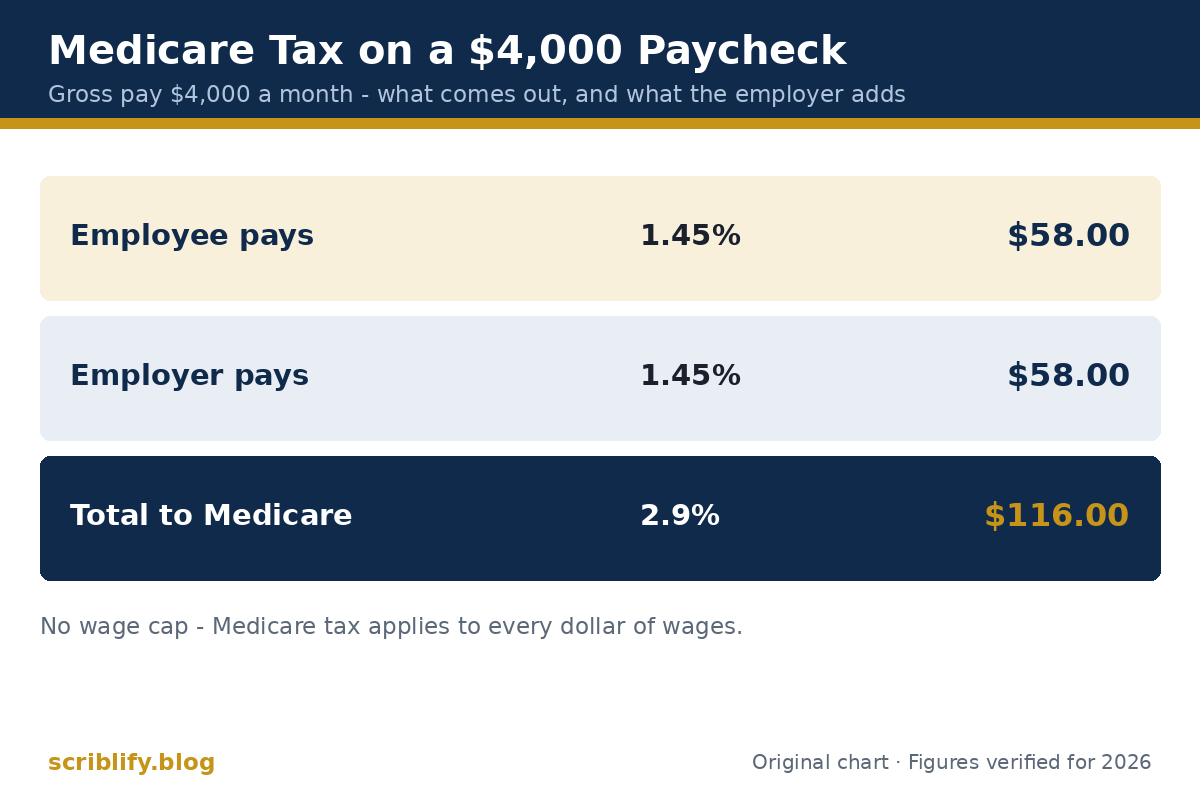
Here is a $4,000 monthly paycheck, step by step:
- Step 1: Start with gross pay: $4,000.
- Step 2: Multiply by the employee rate: $4,000 × 1.45% = $58.00.
- Step 3: Your employer pays the same $58.00 on top of your pay.
So $58.00 leaves your paycheck, and $116.00 reaches Medicare in total.
| Paycheck amount | You pay (1.45%) | Employer pays (1.45%) |
|---|---|---|
| $1,000 | $14.50 | $14.50 |
| $2,000 | $29.00 | $29.00 |
| $4,000 | $58.00 | $58.00 |
Look for “Medicare” on your pay stub. Some stubs shorten it to “MED”. The amount is steady every pay period because the rate is flat.
If you are paid weekly, the math is the same. Take each pay amount, multiply by 1.45%, and you have your number.
What Is the Additional Medicare Tax?
It is an extra 0.9% tax on earnings above set thresholds. Only the employee pays it. Employers do not match it.
| Filing status | Threshold |
|---|---|
| Single | $200,000 |
| Head of household | $200,000 |
| Qualifying widow(er) | $200,000 |
| Married filing jointly | $250,000 |
| Married filing separately | $125,000 |
How do I calculate Medicare tax on a wage over $200,000?
Say your wages are $230,000 and you file single. Regular Medicare tax: 1.45% of the full $230,000 = $3,335. Extra tax: 0.9% of the $30,000 above the threshold = $270. Your total Medicare tax as an employee: $3,605.
Worked example: a single filer earns $230,000 in wages.
- Step 1: Wages above the $200,000 threshold: $230,000 − $200,000 = $30,000.
- Step 2: Extra tax: $30,000 × 0.9% = $270.
- Step 3: The regular 1.45% still applies to the full $230,000.
The extra bill is $270, on top of the normal Medicare tax.
Your employer must start withholding the extra 0.9% once your wages pass $200,000 in the year. This rule applies whatever your filing status.
That can create a mismatch. A married couple filing jointly has a $250,000 threshold, but each employer withholds from $200,000. You settle the true amount on Form 8959 with your tax return. You may owe a little more, or get some back.
The extra 0.9% never applies to employer money. Only your wages and self-employment income count toward the thresholds.
If You Have Wages AND Self-Employment Income
The two are combined for the extra tax. Your wages count first: they use up part of your threshold, and only the self-employment income above what is left is hit by the extra 0.9%. Form 8959 works it out on your return.
For Employers: You report Medicare withholding on Form 941 every quarter, and each employee’s Medicare wages and tax go on their W-2, due by January 31.
What Is the Medicare Tax for the Self-Employed?
Self-employed workers pay both halves: 2.9% on 92.35% of net earnings (You first take 7.65% off your net earnings — that step stands in for the employer’s half, which employees never pay tax on.). There is no employer to split it with.
Worked example: $80,000 of net earnings from freelance work.
- Step 1: Find the taxable base: $80,000 × 92.35% = $73,880.
- Step 2: Apply the 2.9% rate: $73,880 × 2.9% ≈ $2,142.
The 92.35% adjustment stands in for the employer half you never had. It keeps the math fair compared with employees.
There is also relief at filing time. Half of your self-employment tax is deductible as an adjustment to income. It lowers your income tax, though not the Medicare tax itself.
For the full picture, see our self-employment tax guide.
How Does Medicare Tax Compare With Social Security Tax?
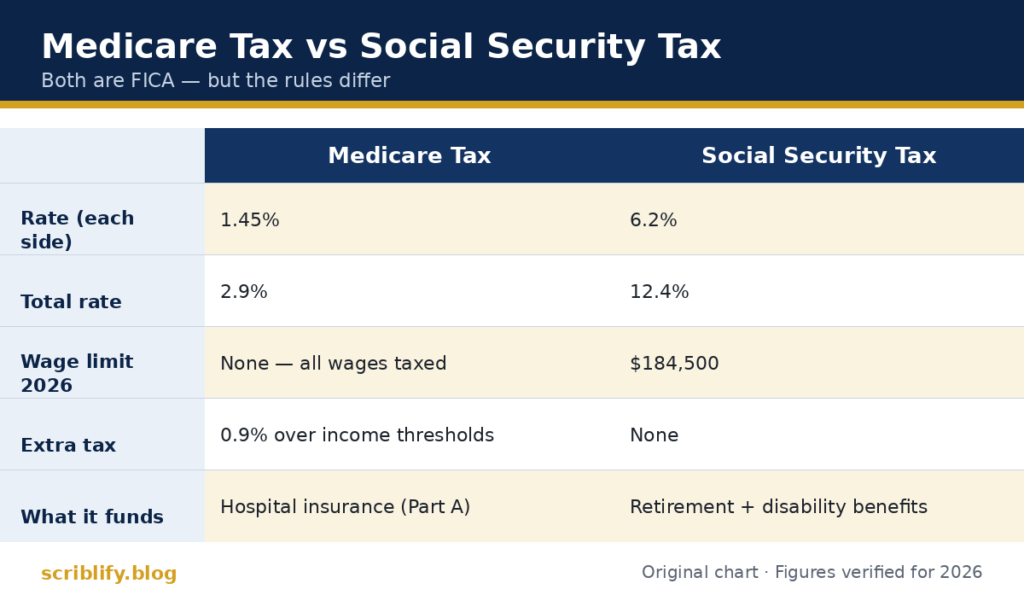
Medicare tax has no wage cap and a lower rate. Social Security tax stops once wages pass the yearly wage base.
| Medicare tax | Social Security tax | |
|---|---|---|
| Employee rate | 1.45% | 6.2% |
| Employer rate | 1.45% | 6.2% |
| Wage limit (2026) | None | $184,500 |
| What it funds | Hospital insurance | Retirement and disability benefits |
Together they are called FICA tax. On wages up to the Social Security cap, you and your employer each pay 7.65% in total.
Above $184,500, only Medicare tax continues. Social Security tax drops to zero for the rest of the year.
Can You Pay Less Medicare Tax?
The rate is fixed by law, so there is no trick to lower it. A few choices change what the rate applies to.
Pre-tax 401(k) contributions do not reduce your Medicare wages. This surprises many people. The money still counts, even though it skips income tax for now.
HSA contributions made through your employer are exempt from Medicare tax. This is one of the few real ways to shrink the base.
Owners of an S corporation split income between salary and distributions. Only the salary faces Medicare tax. The salary must be reasonable for the work, or the IRS can reclassify the distributions.
One legal way employees pay a little less: pre-tax deductions through a workplace cafeteria plan. Money you put into these comes out of your pay before Medicare tax is figured:
- Health, dental and vision insurance premiums paid pre-tax
- A health flexible spending account (FSA)
- A dependent care FSA
Each dollar you route through one of these is a dollar Medicare tax (and Social Security tax) never touches. A 401(k) contribution does not work this way — it lowers your income tax, but Medicare tax still applies to the full amount.
Our guide on how to pay yourself from an LLC compares the salary-and-distributions route with the other pay methods, side by side.
Key Takeaways
- The 2026 Medicare tax rate is 1.45% for employees and 1.45% for employers — 2.9% combined.
- There is no wage cap on Medicare tax.
- The 1.45% rate did not change from 2025.
- High earners pay an extra 0.9% above $200,000 (single) or $250,000 (joint).
- Self-employed workers pay 2.9% on 92.35% of net earnings, and half is deductible.
- 401(k) contributions do not cut Medicare wages; HSA contributions through an employer do.
Paying yourself through draws? Our owner draw guide shows why the amount you draw never changes this tax — only your profit does.
Medicare is only one line on the stub. Our FITW tax meaning guide decodes the whole pay stub — FITW, Social Security, Medicare and state lines — and shows how each amount is worked out.
FAQs
What is the Medicare tax rate for 2026?
The Medicare tax rate for 2026 is 1.45% for employees and 1.45% for employers, or 2.9% combined. Self-employed workers pay the full 2.9% on 92.35% of net earnings. The rate is unchanged from 2025. There is no wage cap. An extra 0.9% applies to high earners above set income thresholds.
What is the Medicare tax rate for employees?
Employees pay 1.45% of all wages in 2026, with no cap. Your employer matches it with another 1.45%, so 2.9% goes to Medicare on your earnings. The 1.45% comes out of every paycheck automatically. High earners also pay an extra 0.9% on wages above their filing-status threshold.
Is there a cap on Medicare tax?
No. There is no wage cap on Medicare tax in 2026, and there has been no cap since 1994. The 1.45% applies to every dollar of wages, from the first to the millionth. This is the big difference from Social Security tax, which stops at the $184,500 wage base in 2026.
What is the Additional Medicare Tax?
The Additional Medicare Tax is an extra 0.9% on earnings above $200,000 for single filers, $250,000 for joint filers, and $125,000 for married filing separately. Only the employee pays it. Employers start withholding it once wages pass $200,000. You settle the final amount on Form 8959 with your return.
How much Medicare tax is taken from a $1,000 paycheck?
$14.50. Multiply $1,000 by the 1.45% employee rate. Your employer pays another $14.50 on top, so $29.00 in total reaches Medicare. The amount is the same every pay period because the rate is flat and there is no wage cap.
Do self-employed people pay more Medicare tax?
Yes, in effect. Self-employed workers pay 2.9% because they cover both the employee and employer halves. It applies to 92.35% of net earnings. The upside: half of the self-employment tax is deductible as an adjustment to income, which lowers income tax.
What is the difference between Medicare tax and FICA?
Medicare tax is part of FICA, not something separate. FICA stands for the Federal Insurance Contributions Act. It covers two taxes: Medicare tax at 1.45% with no wage cap, and Social Security tax at 6.2% up to the $184,500 wage base in 2026.
Who pays the 3.8% Medicare tax?
No one pays 3.8% on wages. The 3.8% figure is the Net Investment Income Tax, a separate tax on investment income — interest, dividends, capital gains, rent — for people whose income passes $200,000 (single) or $250,000 (married filing jointly). It never comes out of a paycheck. The extra Medicare tax on pay is 0.9%, not 3.8%.
Can you opt out of paying Medicare tax?
Almost no one can. Medicare tax is mandatory on wages and self-employment income. The narrow exceptions include some members of recognized religious groups who have formally waived Social Security and Medicare benefits (Form 4029), and some nonresident aliens on certain visas. Most workers cannot opt out.
At what age do you stop paying Medicare tax?
You never stop because of age. Medicare tax has no age limit and no income cap — you pay it on every dollar of wages or self-employment income for as long as you keep earning, even past 65 and even after you start receiving Medicare benefits. It ends only when the earned income does.
Do I get my Medicare tax back?
Not for regular Medicare tax — it is not refundable. If too much of the extra 0.9% Additional Medicare Tax was taken from your pay, Form 8959 settles the difference on your tax return, and any excess comes back as part of your refund.
Does everyone pay $170 for Medicare?
No — and that $170 figure is not the Medicare tax. It was the standard Medicare Part B premium back in 2022. The Part B premium pays for doctor and outpatient cover and is usually taken from a Social Security check, not a paycheck. For 2026 the standard premium is $202.90 a month, and higher incomes pay more.
Conclusion
Medicare tax is simple once you see the numbers. In 2026, you pay 1.45%, your employer pays 1.45%, and there is no cap. High earners add 0.9% above the thresholds, and the self-employed cover both halves.
Want the full picture? Read our payroll and self-employment tax guide for FICA, withholding, and filing in one place.
This guide is educational and is not tax advice.
Leave a Reply