QUICK ANSWER
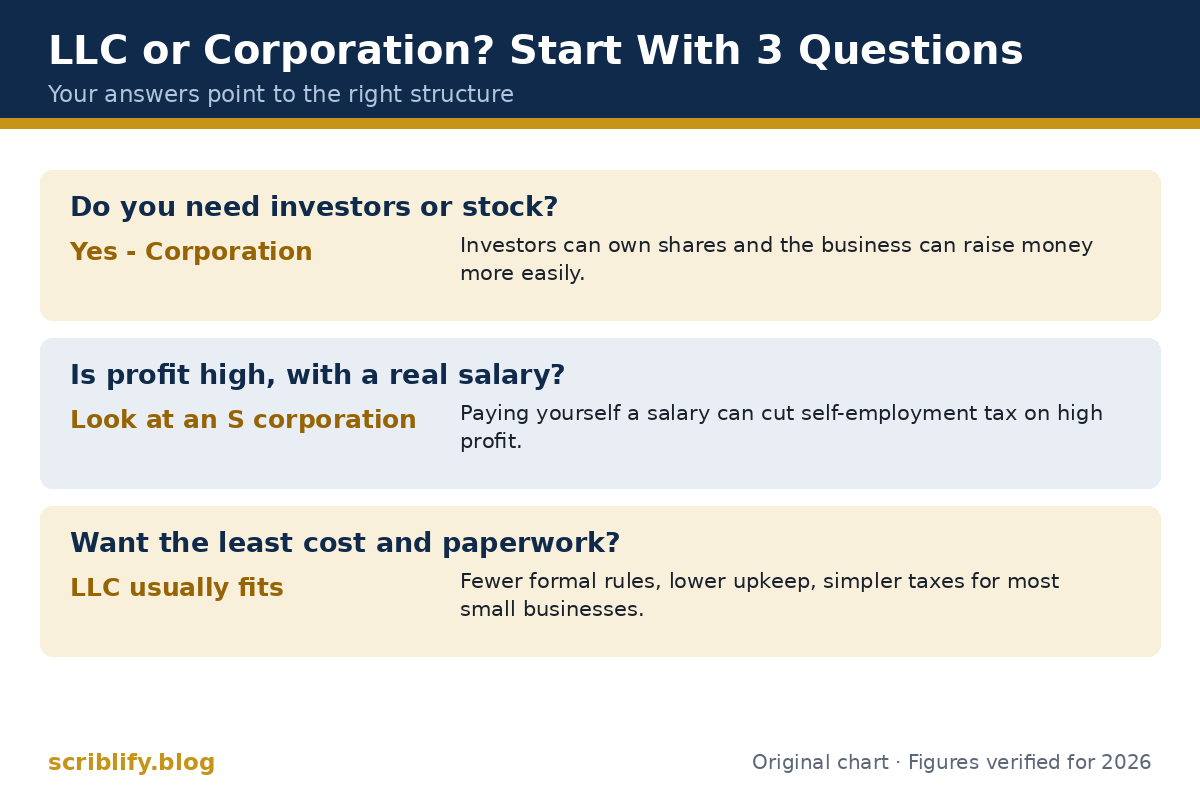
An LLC is owned by members and taxed once, as a pass-through (income passes through to the owners’ personal tax returns — the business itself pays no federal income tax). A corporation is owned by shareholders, pays its own 21% federal tax, and profits are taxed again when paid out as dividends. Most small businesses start as an LLC; a corporation fits when you need investors or stock. There is also a middle path: an LLC can elect to be taxed as an S corporation — it is covered below.
Introduction
LLC or corporation — it is one of the first decisions every new business owner faces, and it affects your taxes, paperwork, and how you pay yourself. Most guides just list features; this one shows the real difference between LLC and corporation taxes in dollars. This guide compares both side by side, with real numbers, so you can choose once and move on.
The Difference Between LLC and Corporation at a Glance
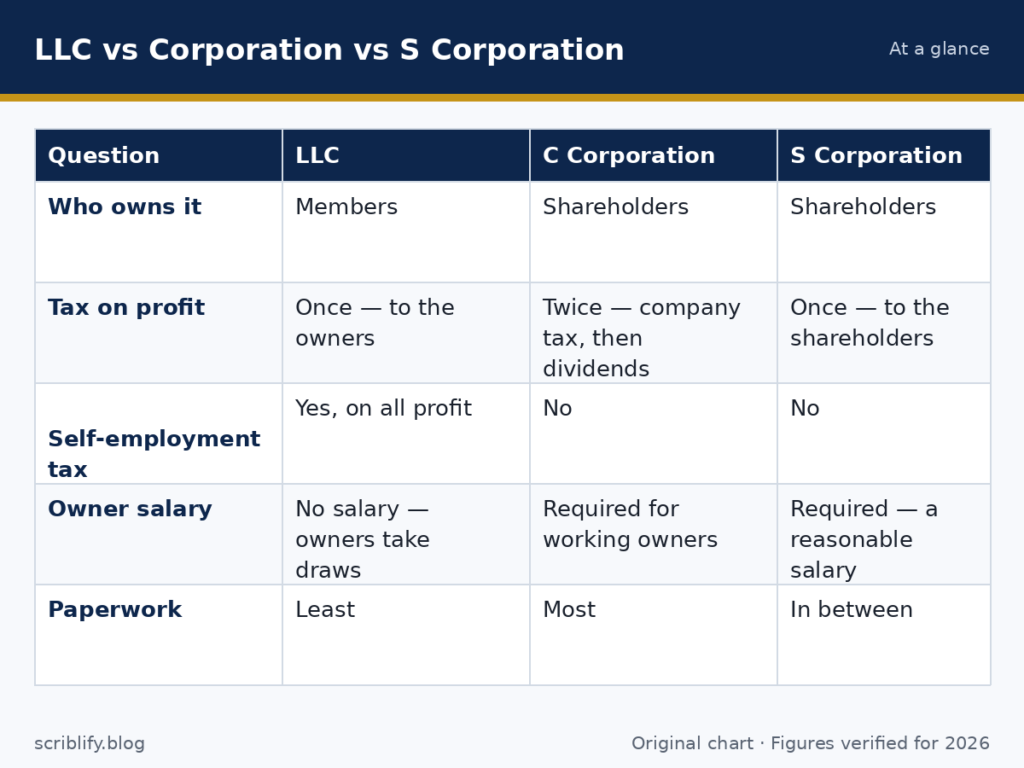
| LLC | C Corporation | S Corporation | |
|---|---|---|---|
| Owners | Members | Shareholders | Shareholders (max 100) |
| Who pays tax on profit | Owners (pass-through) | The company at 21% | Owners (pass-through) |
| Tax on paying yourself | 15.3% self-employment tax | Salary taxed as employee; dividends taxed again | Salary taxed; distributions avoid payroll tax |
| Management | Flexible, your choice | Board + officers, formal | Board + officers, formal |
| Paperwork | Light | Heavy (meetings, minutes, bylaws) | Heavy |
| Raising money | Hard (no stock) | Easy (sell shares) | Limited (one class of stock) |
| Best for | Most small businesses | Startups seeking investors | Profitable owner-run businesses |
What Is an LLC?
An LLC (limited liability company) is a state-registered business that separates you from the company. If the business is sued or owes money, your house and savings are normally protected.
By default, the IRS does not tax the LLC itself. Profit passes through to the owners’ personal returns. One owner means the IRS treats it as a disregarded entity; two or more owners means a partnership. An LLC can also choose to be taxed as a corporation — more on that below. If you run a one-owner LLC, the IRS treats it as a disregarded entity — our disregarded entity guide explains what that means for your return, your EIN, and your W-9.
What Is a Corporation?
A corporation is a fully separate legal “person.” It files its own tax return and pays a flat 21% federal tax on profit. Owners are shareholders, and a board and officers run it under formal rules.
When the company pays profits out as dividends, shareholders pay tax on them again. That second layer is called double taxation, and it is the corporation’s biggest drawback for small businesses. Nonprofits are a separate path: they form as nonprofit corporations and must apply for tax-exempt status.
How Do You Form Each One?
| LLC | Corporation |
|---|---|
| Formation form: Articles of Organization | Articles of Incorporation |
| Internal rules: Operating agreement | Bylaws |
| Ownership units: Membership interests | Shares of stock |
| Yearly state duty: State tax and/or annual report (varies by state) | Franchise tax and/or annual report (varies by state) |
How Do Taxes Differ? A $100,000 Example
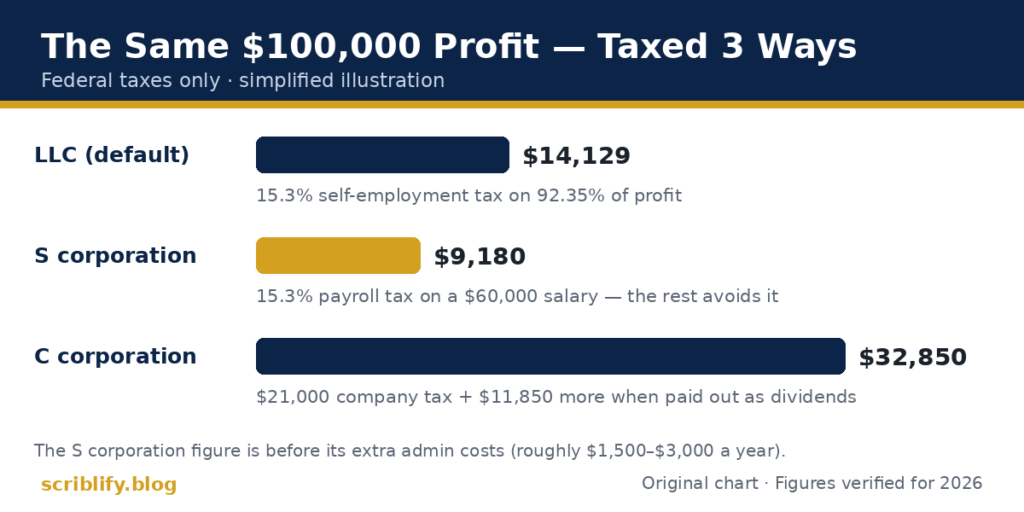
Taxes are where this choice costs or saves real money. Take a one-owner business with $100,000 profit (federal taxes only, simplified, before personal income tax brackets and deductions):
As an LLC (default): you owe self-employment tax on 92.35% (you pay self-employment tax on 92.35% of profit, not on the full amount) of profit at 15.3% → about $14,129. The same profit is also taxed as personal income.
As an S corporation: you pay yourself a $60,000 salary. Payroll tax at 15.3% on the salary = $9,180. The other $40,000 comes out as distributions with no payroll tax. Saving vs the LLC: about $4,949 a year — minus extra costs (payroll service, a second tax return, and extra paperwork).
As a C corporation: the company pays 21% = $21,000. If you take the remaining $79,000 out as dividends at 15% (an example rate — qualified dividends are taxed at 0%, 15% or 20% depending on your income), that is $11,850 more — $32,850 total. Leave the money inside the company, and the 21% rate is the whole bill, which is why growing startups like it.
The lesson: the LLC is simple but the 15.3% self-employment tax bites. The S corporation takes effort but can cut that bill. The C corporation only wins when profits stay in the business or investors are coming. Once you have picked a structure, our guide on how to pay yourself from an LLC shows how owners of each type actually take money out.
What Is an S Corporation, and How Does the Election Work?
An S corporation is not a business type — it is a tax election (Form 2553) that an LLC or a corporation can file. Profit passes through to owners like an LLC, but owners who work in the business must take a reasonable salary first.
The IRS rules: no more than 100 shareholders, all of them US citizens or residents, and only one class of stock. File Form 2553 within 2 months and 15 days of the tax year starting. An LLC can instead elect C corporation tax treatment with Form 8832. One more limit: every S corp shareholder must be a US citizen or resident — a nonresident alien can never own S corp shares.
How Do Ownership and Management Differ?
LLC owners (members) can run the business themselves or appoint managers — the operating agreement sets the rules, and formal meetings are not required.
Corporations must have a board of directors and officers, hold annual meetings, and keep minutes. Ownership moves by selling shares, which is why investors insist on corporations: shares are simple to issue, split, and sell. Corporate shares are usually easier to sell or transfer; LLC ownership transfers follow the rules written in the operating agreement.
How Much Does an LLC vs a Corporation Cost?
| Cost | LLC | Corporation |
|---|---|---|
| State formation filing | One-time state fee | One-time state fee (usually similar) |
| Yearly state charges | Varies — e.g. California LLCs pay an $800 yearly minimum tax; Delaware LLCs pay a flat $400 a year (no annual report) | Varies by state; Delaware corporations pay a franchise tax based on their shares |
| Tax returns | On your personal return (or partnership return) | Separate corporate return every year |
| Ongoing admin | Low | Payroll, meetings, minutes, extra return (S corp) |
Sources: IRS.gov, California Franchise Tax Board, Delaware Division of Corporations. Checked October 2026.
Which One Should You Choose?
Choose an LLC if you are starting out, want the simplest structure, have no plans to raise investment, and want profit taxed once.
Choose an S corporation election if your LLC or corporation is profitably owner-run and the payroll-tax saving beats the extra admin — often true from around $60,000–$100,000 of profit upward.
Choose a C corporation if you plan to raise money from investors, issue stock to employees, or reinvest profits inside the company for growth.
What Are the Most Common Mistakes to Avoid?
- Forming a C corporation by default because it sounds “bigger” — then paying tax twice on money you take home.
- Electing S corporation status too early — at low profit, the payroll and return costs eat the saving.
- Skipping the salary rule — S corporation owners who take only distributions invite IRS trouble; the salary must be reasonable.
- Missing the election deadline — Form 2553 is due within 2 months and 15 days of the tax year.
- Forgetting yearly state duties — state taxes apply to both, and most states also require an annual report from both (Delaware is an exception for LLCs — it charges the $400 tax with no annual report); missing them can dissolve your company.
- Putting appreciated real estate into a C corporation. When the corporation later sells the property, the gain is taxed twice — once inside the corporation and again when the money comes out to you.
What Are the Main Pros and Cons?
LLC: + simple, flexible, taxed once. − 15.3% self-employment tax on all profit; hard to raise investment.
C corporation: + investors and stock; flat 21% on retained profit. − double taxation; heaviest paperwork.
S corporation: + pass-through tax without the 15.3% hit on distributions. − salary and payroll admin; strict ownership limits.
Key Takeaways
- LLC = simple and taxed once, but 15.3% self-employment tax applies to all profit.
- C corporation = 21% company tax plus tax on dividends; built for investors and growth.
- S corporation = the middle path; it can save roughly $5,000 a year at $100,000 profit, at the cost of payroll admin.
- You can start as an LLC and elect corporate tax treatment later — the choice is not permanent.
For a closer look at each advantage on its own, see our guide to the benefits of an LLC.
Does an LLC or a Corporation Protect You Better From Creditors?
Both protect your personal assets from business debts — that is the whole point of forming one. The difference shows up when the debt is yours, not the business’s.
If you personally owe money, a creditor can usually take and sell your shares in a corporation to collect. With an LLC, most states limit that creditor to a “charging order” — they can receive distributions from the LLC if and when the LLC makes them, but they cannot force the LLC to pay out or take over your ownership. The exact rules depend on your state.
Continuity differs too. A corporation keeps existing no matter who owns its shares, so it can outlive its founders easily. An LLC can also continue indefinitely, but what happens when a member leaves or dies is set by state law and your operating agreement — one more reason that agreement matters.
Frequently Asked Questions
Which is better, an LLC or a corporation?
For most small businesses, the LLC. It is simpler, cheaper to run, and profit is taxed once. A corporation is better when you need outside investors, want to issue stock, or will leave profits inside the company to fund growth.
Who pays more taxes, an LLC or a corporation?
It depends on profit and how you take money out. An LLC owner pays 15.3% self-employment tax plus income tax. A C corporation pays 21%, plus tax on dividends. At $100,000 profit, the LLC’s payroll-tax layer is about $14,129; the corporation’s total can reach $32,850 if all profit is paid out.
What is the biggest disadvantage of an LLC?
The self-employment tax: 15.3% on nearly all profit, with no way around it inside a standard LLC. Raising money is the second weakness — an LLC cannot issue stock, so serious investors usually refuse it.
Why is an S corporation better than an LLC?
Because only your salary faces the 15.3% payroll tax; the rest of the profit passes through without it. At $100,000 profit with a $60,000 salary, that saves roughly $4,949 a year. The trade-off is payroll admin, a separate return, and strict ownership rules.
Can I change from an LLC to a corporation later?
Yes. An LLC can elect corporate taxation with Form 8832, or S corporation taxation with Form 2553, without closing the business. Converting the legal entity itself is also possible in most states, but the tax election alone is usually enough.
Is an LLC the same as a corporation?
No. Both protect your personal assets, but they differ in ownership (members vs shareholders), management formality, and above all taxes: pass-through once for the LLC, a separate 21% company tax — often twice — for the corporation.
Is an LLC a sole proprietorship or a partnership?
Neither, exactly. An LLC is a legal structure you form with your state. For taxes, the IRS treats a single-member LLC like a sole proprietorship and a multi-member LLC like a partnership by default — unless you elect to be taxed as a corporation. The legal protection and the tax treatment are two separate things.
How much can an S corp save on $200,000 of profit?
On $200,000 of profit, self-employment tax for a sole proprietor or default LLC is about $28,234 — Social Security tax stops at the $184,500 wage base, which is why the figure is below a flat 15.3%. As an S corp paying a $90,000 salary, payroll tax is $13,770. The saving is roughly $14,464 a year, before the S corp’s extra costs.
Should I use an LLC or a corporation for rental real estate?
For most rental property owners, an LLC. An LLC gives you liability protection with pass-through taxes, so rental income and losses flow onto your personal return. Holding appreciated property in a C corporation is usually a tax trap: when the corporation sells, the gain is taxed at the corporate level and again when the profit is distributed to you.
What if my LLC makes no money?
You may owe no federal income tax, and a single-member LLC with no income usually has no Schedule C to file. But state charges do not stop: California still charges its $800 yearly LLC tax and Delaware its $400 tax, even in a year with no income. Keep the business’s filings and fees current, or the state can dissolve the LLC.
Can I call myself CEO if I own an LLC?
Yes. An LLC can use almost any title its owners choose — CEO, president, founder or managing member. There is no law that saves the CEO title for corporations. Put the title in your operating agreement so it is clear who can sign contracts and act for the business. The title itself gives no extra legal or tax benefit.
What is the 2% rule for an S corporation?
It is about fringe benefits. A shareholder who owns more than 2% of an S corporation is treated like a partner, not an employee, for benefits such as health insurance. Premiums the company pays for that shareholder are added to their W-2 wages (Box 1). The shareholder can then usually deduct them as self-employed health insurance.
Conclusion
Start simple: most small businesses belong in an LLC, elect S corporation taxation when profit makes the saving real, and choose a C corporation when investors or stock enter the picture. Tax rules change and every state differs, so before you file or elect, a short review with a CPA or business attorney is worth it. Still weighing your structure? Our complete LLC tax guide walks through how an LLC is taxed, step by step.
This guide is educational and is not tax or legal advice.
Leave a Reply