Quick Answer
Filing exempt on taxes — claiming exempt from federal income tax withholding — is allowed only if you had no tax liability last year and expect none this year. On the current Form W-4, check the “Exempt from withholding” box, complete only Steps 1(a), 1(b) and 5, and give the form to your employer. Social Security and Medicare tax still come out.
First, a Quick Word: Three Meanings of “Exempt”
The word exempt causes real confusion, because it has three different meanings in tax. This guide is about the first one: (1) exempt from withholding — no federal income tax taken from your paycheck, claimed on Form W-4. It does not mean (2) a tax-exempt organisation, such as a charity that pays no tax itself, and it is not (3) the old personal exemption, which has been $0 since 2018.
Why People File Exempt
Every paycheck feels smaller than it should, and the federal income tax line is usually the biggest cut. If you earned little last year and got all of that tax back as a refund, you may not need to hand it over at all.
Filing exempt on taxes means telling your employer, through Form W-4, that you qualify to have no federal income tax withheld at all. It is not a trick, and it is not for everyone — the IRS sets two strict conditions. Here is who qualifies, the exact steps on the current form, and the deadlines that keep the status in place.
The W-4 Exempt Checklist: 5 Boxes to Tick First
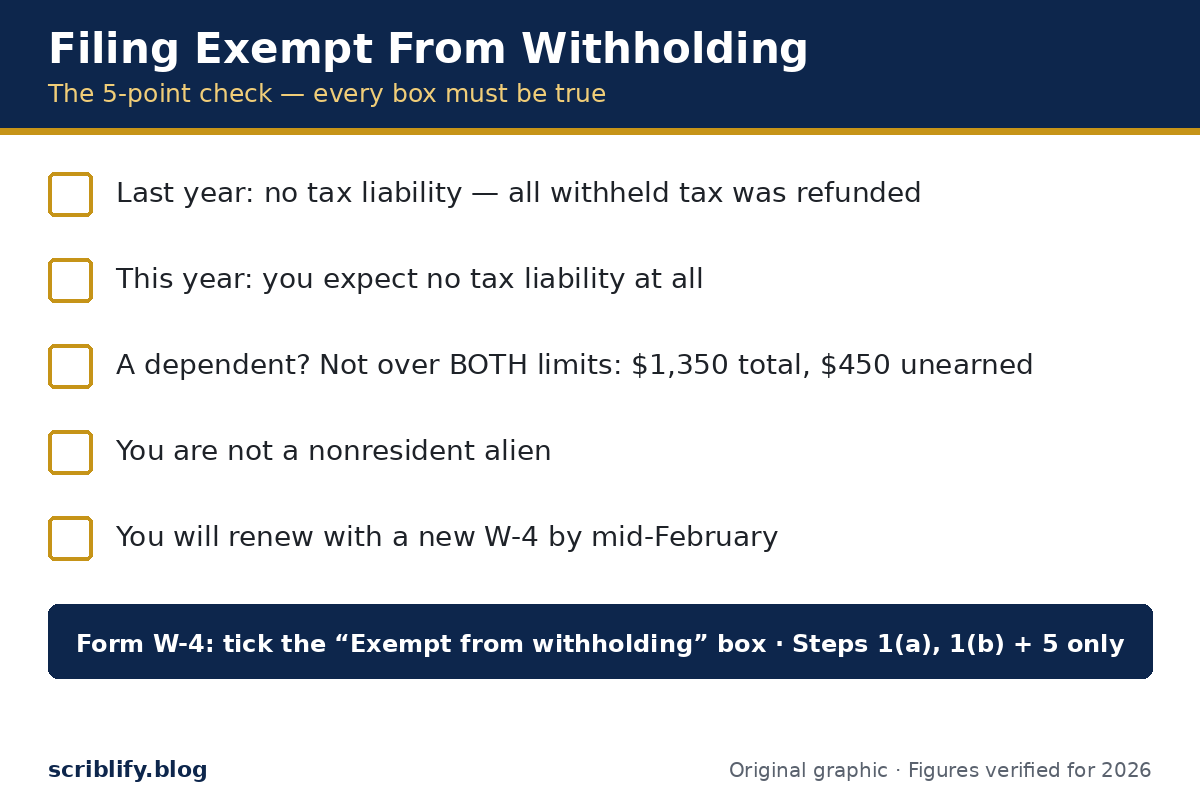
Before you touch the form, run through these five boxes. Every single one must be true for you.
- ☐ Last year: every dollar of federal income tax withheld came back to you as a refund, because you had no tax liability.
- ☐ This year: you expect the same — no tax liability, so any tax withheld would be refunded.
- ☐ If someone can claim you as a dependent: your total income is $1,350 or less, or your unearned income (interest, dividends) is $450 or less.
- ☐ You are not a nonresident alien.
- ☐ You will renew on time: a fresh Form W-4 to your employer by mid-February next year.
If any box stays unticked, do not claim exempt — use the legal ways to lower withholding covered below.
Who Can Claim Exempt From Withholding?
Only people who meet both IRS conditions can claim exempt:
- Last year, you had a right to a refund of all federal income tax withheld, because you had no tax liability.
- This year, you expect the same — a refund of all tax withheld, because you expect no tax liability.
Miss either one and you do not qualify, even if your income is low.
A 30-Second Test Using Last Year’s Return
If you filed a federal return last year, find Form 1040, line 24 — your total tax. If that line is zero, you pass the first condition.
It also counts if line 24 is less than the sum of lines 27a, 28, 29, 31 and 32. Never had to file at all? That usually points to no tax liability too.
What If Someone Can Claim You as a Dependent?
Then an extra test applies. You cannot claim exempt if both of these are true:
- Your total income is over $1,350, and
- Your unearned income — interest and dividends — is over $450.
Both must be over for the bar to apply. IRS Publication 505 gives a clear example. A student earns $2,500 from a summer job and had $375 withheld. That tax all came back as a refund, so the student can claim exempt.
Give the same student $475 of interest income, and the answer flips — now they cannot claim.
One more warning, straight from the IRS: “If you are a student, you are not automatically exempt.” A student job alone does not qualify you. The two conditions do.
How Do I File Exempt on the W-4, Step by Step?
Check the box on the current Form W-4, fill in just three short steps, and hand the form to your employer. That is the whole process.
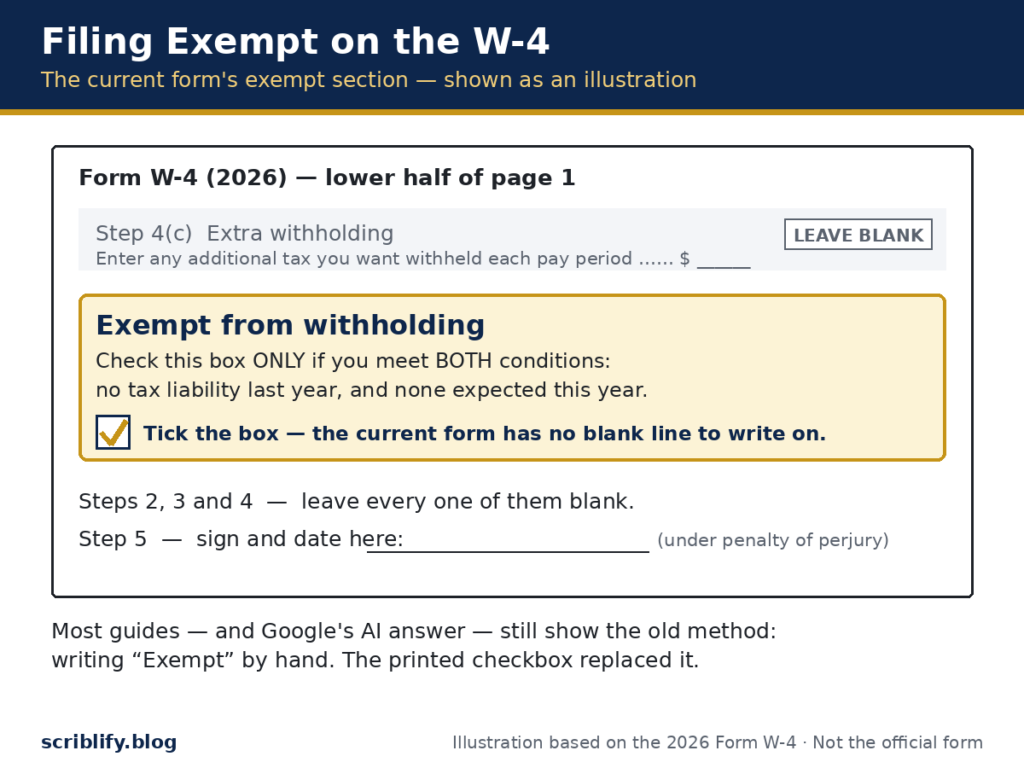
First, ignore the old advice. Some big-name sites — and even Google’s AI answer — still tell you to write “Exempt” in a blank space. That was the old method. The current form has a printed checkbox instead.
- Complete Step 1(a) — your name and address — and Step 1(b) — your Social Security number. Leave Step 1(c), the filing-status boxes, blank.
- Check the box in the “Exempt from withholding” section, below Step 4(c).
- Skip Steps 2, 3 and 4 completely. Do not complete any other steps.
- Sign and date the form in Step 5 — you sign under penalty of perjury that the claim is true — and give it to your employer.
Filing through payroll software instead? Choose the exempt option on screen rather than typing in any blank field. The IRS sets out the same rules in Topic 753.
Does Exempt Stop Social Security and Medicare Tax Too?
No. The exemption covers federal income tax only.
Publication 505 puts it plainly: the exemption applies only to income tax, not to Social Security or Medicare tax. So your pay stub will still show Social Security and Medicare coming out. That is correct — it is not a mistake by your employer.
The line that disappears is the federal income tax one — on many stubs it is labelled FITW, and our FITW tax meaning guide decodes that code. Our Medicare tax rate guide explains the 1.45% that keeps coming out. A different exemption does exist for Social Security and Medicare themselves: members of certain recognised religious groups can apply on Form 4029. That is a separate route, with its own strict conditions — it is not part of the W-4 exempt claim.
How Long Does Exempt Status Last?
One year only. It never rolls over by itself.
To stay exempt, you must give your employer a new Form W-4 by February 15 each year. For the current cycle, the form itself prints the date: submit a new Form W-4 by February 16, 2027 — February 15, 2027 is a federal holiday (Presidents Day).
Two more deadlines matter:
- Claim exempt in 2026 but expect to owe tax in 2027 — a full-time job starting, for example? Then you must file a new Form W-4 by December 1, 2026, without the exempt claim.
- If your situation changes during the year so you will owe tax after all, act fast: a new Form W-4 is due within 10 days of the change.
What If I Miss the Renewal Deadline?
Your employer must start withholding again — as if you were Single (or Married filing separately), with no entries in Steps 2 to 4. That is the IRS rule once an exempt Form W-4 expires.
A late form only fixes the future. It applies to wages paid after you file it, not to pay you already received.
Tax your employer already withheld stays withheld. You cannot ask payroll to hand it back — it gets settled when you file your tax return.
Can I Claim Exempt for Just One Paycheck?
No. Exempt is a status, not a switch you flip for one big paycheck.
You either meet both conditions or you do not. There is no one-paycheck version of the claim, and no three-month or six-month version either. Filing a new W-4 is allowed at any time — what you cannot do is claim the exempt status itself for a period when the two conditions are not true.
If your real goal is simply a bigger paycheck, there are legal ways to lower withholding instead. Claim your dependents in Step 3 of the W-4, or enter other deductions in Step 4(b). The IRS Tax Withholding Estimator walks you through the right entries for your situation.
What Happens If I Claim Exempt and Don’t Qualify?
The IRS can charge a $500 penalty for a claim made with no reasonable basis.
Your claim may also be reviewed. If the IRS decides it is wrong, it sends your employer a “lock-in letter.” You get a chance to respond before it takes effect.
After a lock-in, your employer must withhold at the rate the IRS sets. If you want exempt status from that point, you deal with the IRS directly — not with your employer.
Exempt vs. “Claiming 0” — What’s the Difference?
They are not the same thing, and “claiming 0” no longer exists.
Before 2020, workers claimed allowances on the W-4, and claiming 0 allowances meant the most tax withheld. The 2020 redesign removed allowances completely — there is no 0 to claim on today’s form.
Exempt is a separate status, with its own checkbox and its own two conditions. And a plain W-4 with nothing in Steps 2 to 4 is not “exempt” either — tax still comes out, just with no adjustments.
Does Federal Exempt Cover My State Taxes?
No. State withholding is a separate system, with its own forms and its own rules.
Nine states have no income tax on wages at all — Alaska, Florida, Nevada, New Hampshire, South Dakota, Tennessee, Texas, Washington and Wyoming — so in those states there is no state withholding to exempt yourself from.
A federal exempt claim does not automatically carry over to your state. Many states have their own exemption form, and their conditions can differ from the federal ones.
If you want no state tax withheld either, check your state tax agency’s rules and file whatever state form it requires.
Key Takeaways
- Exempt means no federal income tax withheld — Social Security and Medicare tax still come out of every paycheck.
- You qualify only with no tax liability last year and none expected this year.
- On the current Form W-4, tick the “Exempt from withholding” checkbox and complete only Steps 1(a), 1(b) and 5 — the old “write exempt” advice is outdated.
- Dependents face an extra test: total income over $1,350 and unearned income over $450 bars the claim.
- The status lasts one year. Renew by mid-February — February 16, 2027 for the current cycle.
- Claiming without qualifying risks a $500 penalty and an IRS lock-in letter.
FAQs
How do I file exempt on taxes?
Get the current Form W-4. Fill in Step 1(a) with your name and address and Step 1(b) with your Social Security number. Then check the “Exempt from withholding” box below Step 4(c), skip every other step, sign in Step 5, and hand the form to your employer.
Can a student claim exempt from withholding?
Yes, but being a student alone does not qualify you. You still need both conditions: no tax liability last year and none expected this year. If your parents can claim you as a dependent, you also fail the test when your income tops $1,350 and your unearned income tops $450.
If I file exempt, do Social Security and Medicare still come out of my pay?
Yes. Publication 505 is explicit: the exemption applies only to income tax, not to Social Security or Medicare tax. Your stub will still show both FICA lines, and that is correct. Only the federal income tax line — often labelled FITW — drops to zero.
Can I claim exempt for one paycheck, or for a few months?
No. Exempt is a status you qualify for or you do not — there is no short-term version. Claiming it without meeting both conditions can bring a $500 penalty and a lock-in letter. To reduce withholding lawfully, adjust Step 3 or Step 4(b) instead, using the IRS Tax Withholding Estimator.
What happens if I forget to renew my exempt Form W-4?
Your employer must start withholding again, treating you as single or married filing separately with no entries in Steps 2–4. A replacement form only affects pay you receive after filing it. Tax already withheld is not returned by your employer — it is settled when you file your return.
Is claiming exempt the same as claiming 0?
No. Claiming 0 belonged to the old allowance system, which ended when Form W-4 was redesigned for 2020. There are no allowances and no 0 on today’s form. Exempt is a separate checkbox with two strict conditions — no tax liability last year, and none expected this year.
Will I still get a refund if I file exempt?
Not a refund of withholding — if no federal income tax was taken out of your pay, there is nothing withheld to hand back. You can still receive money at filing time if you qualify for refundable credits, such as the earned income credit: those are paid to you even when your tax is zero. For most exempt filers, the benefit is simply bigger paychecks during the year instead of a refund after it.
Can a nonresident alien claim exempt from withholding?
No. Nonresident aliens may not claim exempt from withholding on Form W-4, even if they expect no US tax liability. Different withholding rules apply to nonresident aliens, set out in IRS Notice 1392. If that is your situation, check those rules — or ask a tax professional — before filing anything.
How much will I owe if I claim exempt but don’t qualify?
You would owe your full federal income tax when you file, all at once, instead of in pieces through the year — plus possible underpayment penalties and interest, because the tax was due as you earned. Add the separate $500 penalty if the exempt claim itself had no reasonable basis. How much that is depends entirely on your income; the IRS Tax Withholding Estimator shows your likely bill before you risk it.
Conclusion
Filing exempt is simple when you truly qualify: two conditions, one checkbox, three short steps on the form. It goes wrong when people treat it as a pay-raise trick — that path ends in a penalty or a lock-in letter.
Not sure which side of the line you are on? Run the IRS Tax Withholding Estimator first, or ask a tax professional. Employers can find their side of withholding in our payroll and self-employment tax guide.
This guide is educational and is not tax advice.
Leave a Reply