Quick Answer
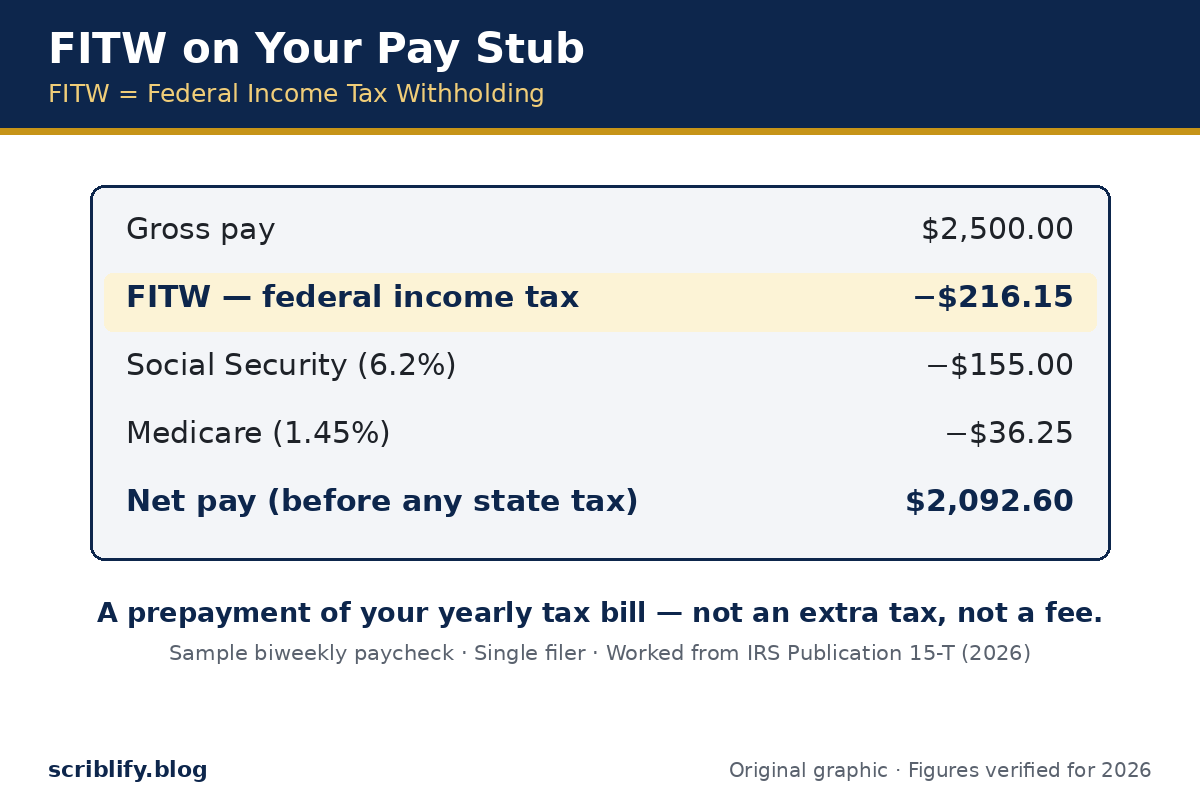
The FITW tax meaning, in one line: FITW is the federal income tax your employer has already sent to the IRS from this paycheck. It is a prepayment of your yearly tax bill, not an extra tax or a fee. FITWH is the same line with a different spelling. Your total FITW for the year becomes a credit on your tax return.
You opened your pay stub, saw a line marked “FITW” or “FITWH,” and a noticeable chunk of your pay gone into it. That worries a lot of people — especially when the amount looks bigger than expected.
Here is the calm version: nothing has gone wrong, and the money is not lost. FITW is your own tax, paid in small pieces as you earn — and you get credit for every dollar when you file. This guide decodes the line, shows how the number is worked out, and explains how to check it or change it.
What Does FITW Mean on Your Pay Stub?
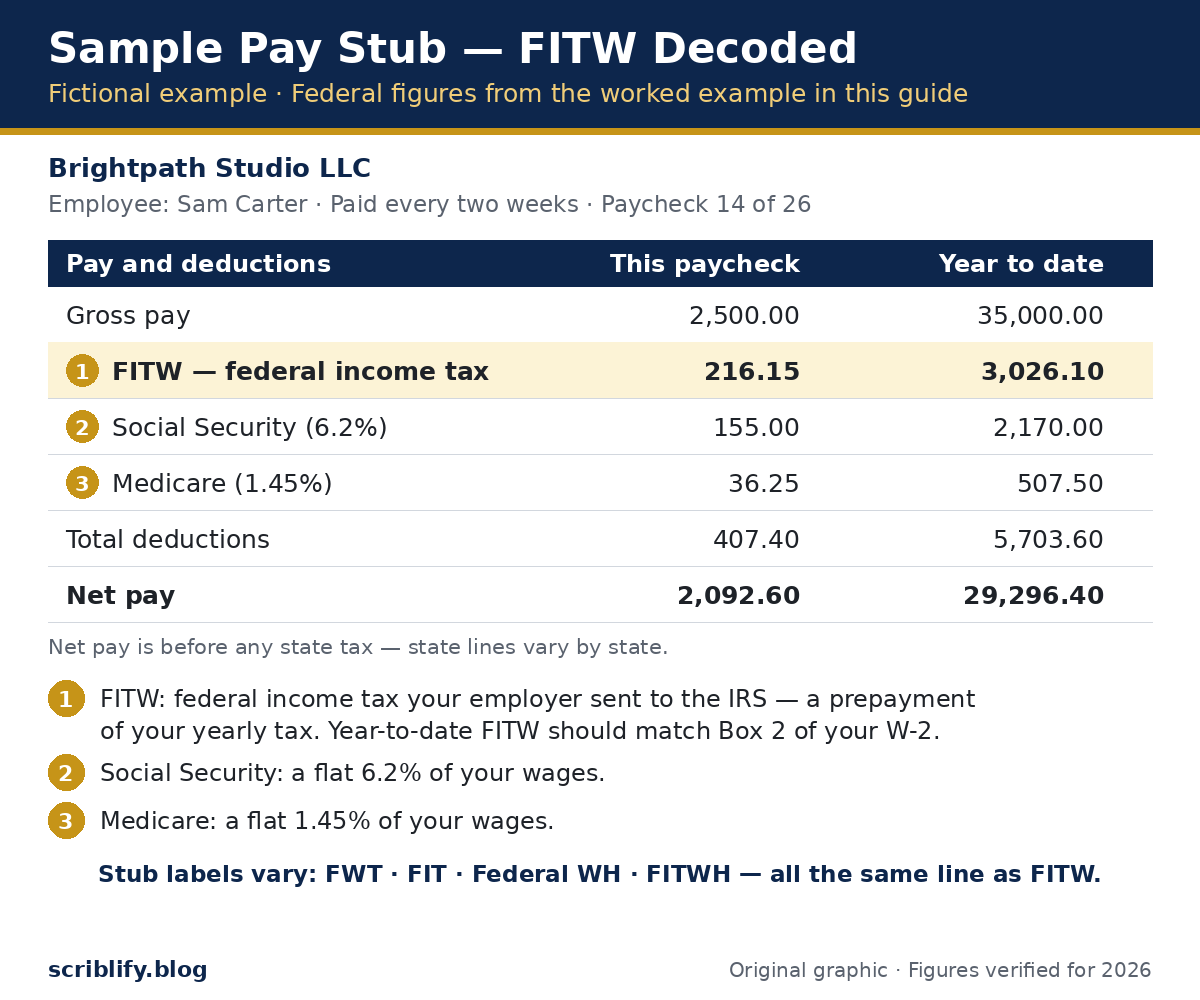
FITW stands for Federal Income Tax Withholding — the federal income tax your employer takes out of each paycheck and sends to the IRS in your name.
The US runs on a pay-as-you-go system: instead of one giant tax bill in April, your employer withholds an estimated amount from every paycheck and passes it to the IRS. When you file, all of it counts as already paid.
One honest detail: the IRS itself never uses the abbreviation “FITW” — official documents always write “federal income tax withholding” in full. FITW is just payroll shorthand, the short label your payroll system prints on the stub. The IRS page on tax withholding explains the system in the IRS’s own words.
Withholding applies to wages, salaries, bonuses, commissions and tips. It does not apply to independent contractors: nobody withholds from a contractor’s pay, so contractors pay their own tax in quarterly estimated payments instead.
Is FITWH the Same Thing as FITW?
Yes. FITWH and FITW are two spellings of the same line — federal income tax withholding. Neither one is a separate tax.
Payroll systems label this line in different ways. Depending on your system, you may see any of these:
| On your stub | What it means |
|---|---|
| FITW | Federal Income Tax Withholding |
| FITWH | Federal Income Tax Withholding |
| FWT | Federal Withholding Tax |
| FWH | Federal Withholding |
| FIT | Federal Income Tax |
| Federal Tax | Federal income tax withholding |
| Federal Withholding | Federal income tax withholding |
The wording varies by payroll provider. As a common convention, ADP stubs often show “FIT” or “Fed Income Tax,” Paychex may show “FWT” or “Federal WH,” QuickBooks Payroll tends to print “Federal Withholding,” Gusto prints “Federal Income Tax,” and military stubs often use “FITW” or “FITWH.” Different label, same deduction.
What Do the Other Codes on Your Pay Stub Mean?
Your FITW line sits next to several other codes — and they are not all the same kind of tax:
| Code | What it is | Who pays it | Flat rate or varies? | Where it lands on your W-2 |
|---|---|---|---|---|
| FITW / FITWH | Federal income tax withholding | You, out of your pay | Varies — based on your pay and your Form W-4 | Box 2 |
| FICA – SS | Social Security tax | You pay 6.2%; your employer pays the other 6.2% | Flat 6.2% of your wages | Boxes 3 and 4 |
| FICA – MED | Medicare tax | You pay 1.45%; your employer pays 1.45% | Flat 1.45% of your wages | Boxes 5 and 6 |
| SITW | State income tax withholding | You, out of your pay | Varies by state; some states have no income tax | The state section of your W-2 |
| SUI | State unemployment insurance | Normally your employer, not you | Varies by state | Not on your W-2 |
The key distinction: FITW varies from person to person because it follows your income and your W-4, while FICA — the combined Social Security and Medicare tax — is a flat percentage. For a deeper look at the Medicare line, see our guide to the Medicare tax rate.
And note the SUI line: it is normally a cost your employer pays. If you ever see it deducted from your own pay, that is worth a polite question to payroll.
How Is FITW Calculated? A Worked Example
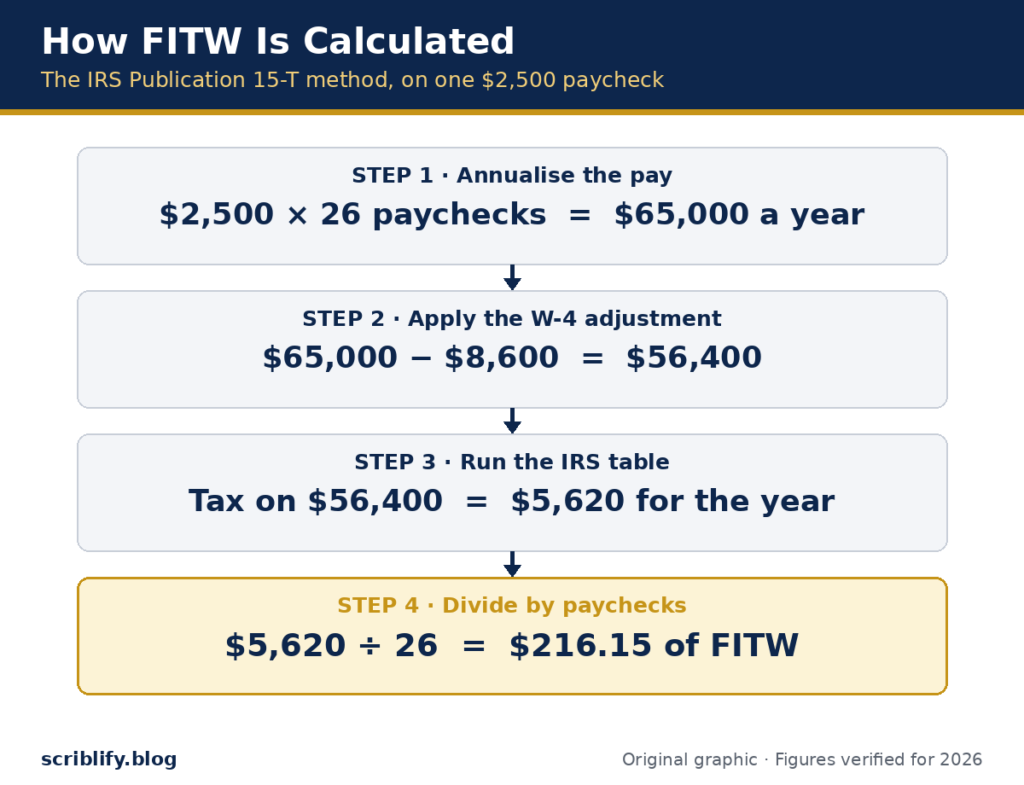
Your employer works it out using the IRS’s official method in Publication 15-T: stretch one paycheck out to a full year, apply your W-4 details, find the yearly withholding, then divide it back down per paycheck.
Here is a real example, calculated from the 2026 Publication 15-T worksheet. Say you are paid every two weeks, earn $2,500 gross per paycheck, have no pre-tax deductions, and your W-4 says Single — with the Step 2 multiple-jobs box not checked and nothing in Steps 3 or 4.
- Annualise the pay. $2,500 × 26 paychecks = $65,000 a year.
- Apply the built-in adjustment. The worksheet subtracts $8,600 for a single filer whose Step 2 box is not checked: $65,000 − $8,600 = $56,400.
- Run the IRS table. For a single filer, the first $7,500 is taxed at 0%, the next band at 10%, then 12%. On $56,400, the table gives $1,240 + 12% of ($56,400 − $19,900 = $36,500), which is $1,240 + $4,380 = $5,620 for the year.
- Divide by paychecks. $5,620 ÷ 26 = $216.15 of FITW per paycheck.
On that same stub, Social Security would take 6.2% ($155.00) and Medicare 1.45% ($36.25), leaving $2,092.60 before any state tax or other deductions.
The teaching point: withholding is an estimate by design. It cannot know about your other income, deductions, or credits — so it lands close, not exact. Your final tax is settled on your return: withheld too much, you get a refund; too little, you pay the difference. Employers run this same machinery every pay run — our payroll and self-employment tax guide covers that side in full.
Why Is My FITW So High on This Paycheck?
Usually, nothing is broken. Withholding reacts to this paycheck as if you earned that amount every pay period — so anything that makes one paycheck bigger makes the FITW jump with it.
- A bonus or overtime. One fat paycheck gets annualised as if it were your normal pay, so a bigger slice is withheld now. It settles at filing time — the extra comes back as a refund or a smaller bill.
- Your first paycheck at a new job. A mid-year start can look odd next to your old job’s pattern — and a new stub format makes the FITW line stand out.
- A second job without the Step 2 checkbox. If you work two jobs and neither W-4 has the multiple-jobs box checked, each job withholds as if it were your only income — and the combined result can be too little or, once corrected, suddenly higher.
- An old W-4 after a life change. Marriage, a new baby, or a spouse starting or leaving a job changes your real tax picture — a W-4 from years ago keeps withholding by the old one.
Is My FITW Amount Normal? Two Quick Checks
You do not need to guess. Two checks take a few minutes:
- The year-end match. Your last pay stub of the year shows a year-to-date FITW total. That figure should match Box 2 of the W-2 your employer sends you in January — if it does, your withholding was recorded correctly.
- The Estimator check. The IRS Tax Withholding Estimator takes a recent pay stub and your W-4 answers and projects whether you are heading for a refund or a bill. Run it once a year, and again after any big life or job change.
One genuine warning sign: FITW of $0 all year when you fully expect to owe tax. That deserves a question to payroll before it becomes an April surprise.
How Can You Change Your FITW Amount?
You cannot edit the line on your stub — but you can change what drives it. File a new Form W-4 with your employer, and payroll applies it going forward.
- To withhold less: Step 3 of the W-4, where you claim dependents and credits, lowers the amount taken out.
- To withhold more: Step 4(c) lets you add a fixed extra amount to every paycheck — useful if you have side income your employer cannot see.
- Two jobs in the household: the Step 2 checkbox switches payroll to the higher withholding the form builds in for multiple-job households.
Before you file the new W-4, run the Estimator above so you are adjusting toward a target, not guessing.
Myth check: “Just claim 0 or 1 allowances.” Withholding allowances ended with the 2020 Form W-4 redesign — Publication 15-T says so. Today’s W-4 has no allowances to claim; it uses Steps 1 to 4 instead. If a website explains your withholding through allowances, it is out of date.
What Happens to Your FITW at Tax Time?
It all meets up on your W-2. Box 1 shows your taxable wages for the year — often lower than your total gross pay if pre-tax deductions such as a 401(k) or health premiums reduced them. Box 2 shows the total FITW withheld across all your paychecks.
On your tax return, that Box 2 total counts as money you have already paid toward your bill. It is a credit, not a deduction — it reduces what you owe dollar for dollar. Withheld more than your final tax? The difference comes back as a refund. Withheld less? You pay the difference.
Key Takeaways
- FITW and FITWH are the same line: federal income tax your employer sends to the IRS from each paycheck.
- It is a prepayment, not an extra tax — your yearly total is credited on your tax return, and any excess comes back as a refund.
- The amount depends on how much you earn and what your Form W-4 says; the IRS method sits in Publication 15-T.
- A single big paycheck (bonus, overtime) spikes FITW temporarily — it settles when you file.
- Check yourself in minutes: your last stub’s year-to-date FITW should match W-2 Box 2, and the IRS Estimator projects your year.
- To change the amount, file a new W-4 — Step 3 lowers it, Step 4(c) adds a fixed extra per paycheck.
Frequently Asked Questions
Why is my FITW so high?
The most common reason is a bigger-than-usual paycheck: withholding treats it as if you earned that amount all year, so a bonus or overtime pushes more into FITW for that one period. A second job without the Step 2 checkbox, or an outdated W-4, can also push it up. It settles when you file.
Do I get my FITW back?
You get back only the part that exceeds your final tax bill. Your total FITW for the year is credited against the tax you actually owe: if you withheld more than that, the difference is refunded; if you withheld less, you pay the shortfall. FITW itself is not a savings account — it is your tax, paid early, in pieces.
What should my FITW be?
There is no single correct number, because it depends on your pay, your filing status, your dependents, and your other income — all the things your W-4 captures. The only reliable personal figure comes from the IRS Tax Withholding Estimator, using a recent pay stub. If it projects a large refund or a large bill, a fresh W-4 can bring you closer to even.
How much FITW is withheld on a $30,000 salary?
Using the same 2026 Publication 15-T method as the worked example above — single filer, paid every two weeks, plain W-4 — a $30,000 salary annualises to $30,000, minus the $8,600 adjustment = $21,400. The table gives $1,420 of withholding for the year, which is $54.62 per paycheck. Your own figure moves with your W-4, pay schedule and pre-tax deductions.
What percentage of my paycheck goes to FITW?
There is no fixed percentage — FITW is worked out from the IRS tables, not charged at a flat rate like Social Security or Medicare. In the worked example above, $216.15 comes out of a $2,500 paycheck, which is about 8.6%. Lower pay can come out at 0%; higher pay pushes the percentage up, because the tables are progressive.
Can I opt out of FITW?
Generally, no. Federal income tax withholding is not optional for most employees. The one exception is claiming exempt from withholding, and that is allowed only if you meet both conditions: you had no federal tax liability last year, and you expect none this year. If that genuinely describes you, read our guide to claiming exempt from withholding before you file anything.
Is FITW the same as FICA?
No. FITW is your federal income tax, and it varies with your earnings and your W-4. FICA is the payroll tax for Social Security and Medicare, charged at flat rates — 6.2% for Social Security and 1.45% for Medicare from your pay. They are separate lines, calculated in completely different ways, and both appear on your W-2 in different boxes.
Why is my FITW zero?
At lower pay levels, the IRS tables can produce zero withholding: once your paycheck is annualised and your W-4 adjustments are applied, the taxable amount can fall inside the 0% band. Claiming exempt also sets FITW to zero. But if your pay is solid and FITW stays at zero all year, ask payroll to check — under-withholding becomes a bill at filing time.
Is it bad if no federal taxes are withheld from my paycheck?
Not always. At low pay, the IRS tables can lawfully produce zero withholding, and a genuinely exempt employee also has none. It becomes a problem when you will owe tax at filing time and nothing was withheld — then the full bill lands at once, possibly with an underpayment penalty. If FITW is $0 and your pay is not low, run the IRS Tax Withholding Estimator or ask payroll to check.
Conclusion
FITW looks alarming because it is one of the biggest lines on the stub — but it is simply your own income tax, paid gradually and credited to you in full at filing time. Once you know it follows your pay and your W-4, you can predict it, check it against your W-2, and adjust it whenever life changes.
Take five minutes to run your numbers through the IRS Tax Withholding Estimator — it is the fastest way to know whether your FITW is on track. If your situation involves multiple jobs, side income, or self-employment on top of a salary, a CPA can sanity-check your W-4 so April holds no surprises.
This guide is educational and is not tax advice.
Leave a Reply