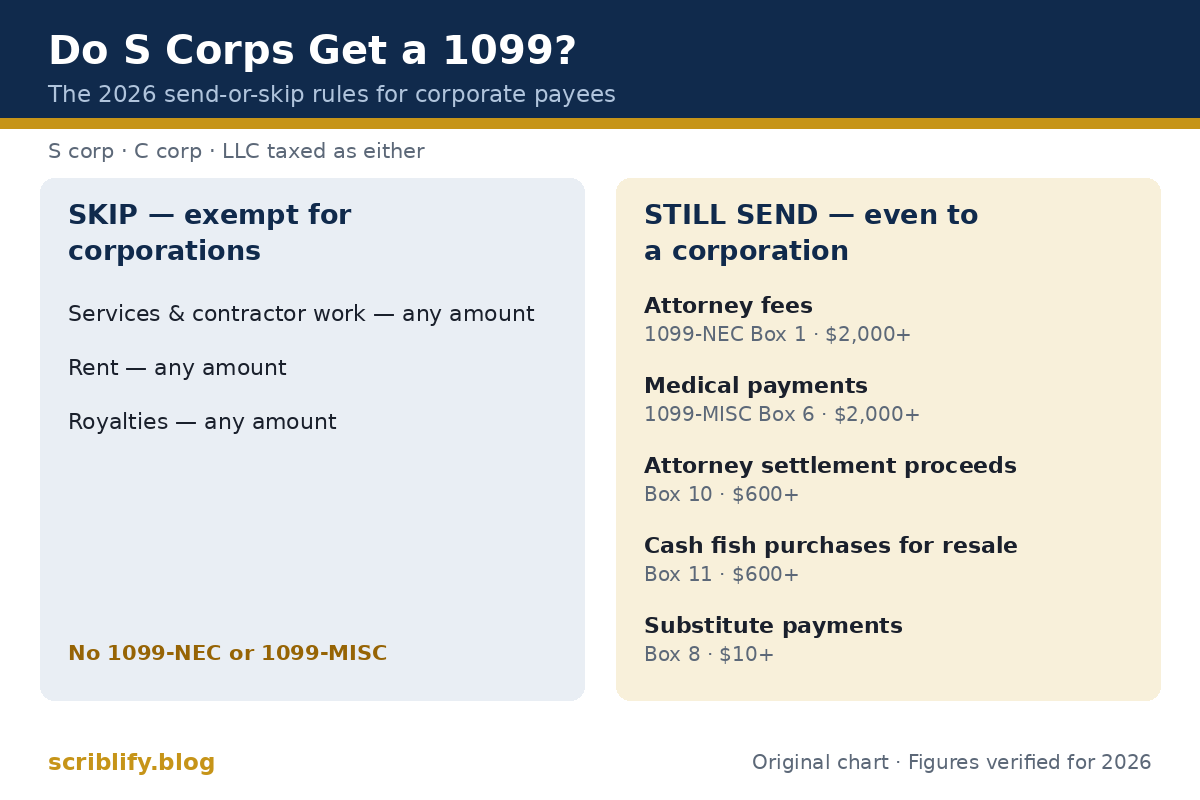
Quick Answer: Do S corps get 1099? No. Payments to an S corporation are exempt from Form 1099-NEC and 1099-MISC reporting, and the same exemption covers C corporations and LLCs taxed as either one. A few payments still get reported even to corporations — most commonly attorney fees, medical payments, and settlement proceeds paid to attorneys. For 2026, the main threshold is $2,000, not $600.
You paid an S corporation $8,000 last year — and now January is here. Does this company get a 1099, or not?
This guide settles it — the simple rule, the short list of exceptions, the new 2026 dollar limits most websites still get wrong, and a decision matrix you can run any payment through in seconds.
Do S Corps Get 1099? Why Corporations Are Exempt From Reporting
The IRS puts corporations on its exempt list. The instructions for Forms 1099-NEC and 1099-MISC exempt payments to a corporation — a C corporation, an S corporation, or an LLC taxed as one of them (Reg. §1.6041-3(p)). The exemption covers both forms, at any dollar amount.
In plain words: a corporation is not a “contractor” for 1099 purposes, even when it does contractor-style work for you. Pay an S-corp design studio $800 or $80,000 for ordinary services — no form is due either way.
Instead of a 1099, the IRS tracks the payee through Form W-9, where a corporation marks itself as an exempt payee (code 5). The signed W-9 in your files is your proof — how to read it comes below.
Send or Skip? The 2026 Decision Matrix
Run any payment through this table: find the type, then check your payee’s column. Not sure which 1099 form a payment belongs on at all? Our 1099-NEC vs 1099-MISC guide compares the two forms payment by payment.
| Payment in 2026 | Corporation (S corp, C corp, or LLC taxed as one) | Sole proprietor, partnership, or LLC taxed as one |
|---|---|---|
| Services and contractor work | Skip — exempt at any amount | Send — Form 1099-NEC, Box 1, at $2,000+ |
| Rent | Skip — exempt at any amount | Send — Form 1099-MISC, Box 1, at $2,000+ |
| Attorney fees for legal services | Send — Form 1099-NEC, Box 1, at $2,000+ | Send — Form 1099-NEC, Box 1, at $2,000+ |
| Medical and health care payments | Send — Form 1099-MISC, Box 6, at $2,000+ | Send — Form 1099-MISC, Box 6, at $2,000+ |
| Settlement proceeds paid to an attorney | Send — Form 1099-MISC, Box 10, at $600+ | Send — Form 1099-MISC, Box 10, at $600+ |
| Cash paid for fish bought for resale | Send — Form 1099-MISC, Box 11, at $600+ | Send — Form 1099-MISC, Box 11, at $600+ |
| Substitute payments (for dividends or tax-exempt interest) | Send — Form 1099-MISC, Box 8, at $10+ | Send — Form 1099-MISC, Box 8, at $10+ |
| Paid by card or a payment network | Skip — the processor files Form 1099-K (for 2026: more than $20,000 and more than 200 transactions) | Skip — the processor files Form 1099-K (for 2026: more than $20,000 and more than 200 transactions) |
| Royalties | Skip — royalties paid to a corporation are exempt, like rent. | Send — Form 1099-MISC, Box 2, at $10+ |
| Merchandise only (no services) | Skip — 1099s cover services, not goods alone. | Skip — 1099s cover services, not goods alone. |
Three things to know about this table:
- Every threshold is per payee, added up across the year — not per invoice.
- Two “send” cases sit outside the table: a federal executive agency paying a corporation for services must still file, and any payment with backup withholding gets reported at any amount.
- Not sure which column fits your payee? Their Form W-9, line 3a, tells you — see below.
What Do Real 2026 Payments Look Like?
Five real payments, five answers — payee status and payment type decide.
- $8,000 to an S-corp web designer → Skip. Services to a corporation are exempt at any amount.
- $2,400 to your law firm, which is incorporated → Send Form 1099-NEC, Box 1. Attorney fees are the big exception, and $2,400 passes the $2,000 limit.
- $900 in settlement proceeds sent to a corporate law firm → Send Form 1099-MISC, Box 10. Gross proceeds to attorneys kept the old $600 limit — it did not rise.
- $1,500 to an S-corp clinic for staff physicals → Skip in 2026. Medical payments to a corporation count only at $2,000 or more now; under the old $600 rule, this one needed a form.
- $900 in cash for fish bought for resale from a corporation → Send Form 1099-MISC, Box 11. A small, easy-to-miss exception that kept the $600 limit too.
Do C Corps Get a 1099?
No — a C corporation gets the same exemption as an S corporation.
The exemption does not split the two types apart. If the payee is a corporation on its W-9 — C or S — ordinary payments for services, rent, and royalties are never reported. If you are still weighing the structures themselves, our LLC vs corporation comparison breaks down how each one is taxed and what it costs to run.
The same exceptions still get filed: attorney fees, medical payments, settlement proceeds paid to an attorney, cash fish purchases, and substitute payments. So if you came here asking “do C corps get 1099,” every table and threshold in this guide applies exactly as written.
Which Payments to Corporations Still Get Reported?
Six kinds of payments lose the exemption, even when the payee is a corporation:
- Attorney fees for services — Form 1099-NEC, Box 1, at $2,000 or more, even when the law firm is incorporated.
- Medical and health care payments — Form 1099-MISC, Box 6, at $2,000 or more. Two carve-outs: payments to tax-exempt hospitals and government-run facilities are not reported, and neither are prescription drugs bought from a pharmacy.
- Gross proceeds paid to an attorney — Form 1099-MISC, Box 10, at $600 or more. Settlement money sent to a lawyer on a client’s behalf; its limit stayed at $600.
- Cash for fish bought for resale — Form 1099-MISC, Box 11, at $600 or more. Another limit that did not move.
- Substitute payments — Form 1099-MISC, Box 8, at $10 or more (payments in place of dividends or tax-exempt interest).
- Services bought by a federal executive agency — when a federal agency buys services from a corporation, it still reports them on Form 1099-NEC.
One rule overrides all of the above: a payment you applied backup withholding to gets reported regardless of amount or payee status.
What Changed in 2026? The New $2,000 Threshold
The basic limit jumped from $600 to $2,000 — and most websites have not caught up.
The One Big Beautiful Bill Act (OBBBA) raised the reporting threshold from $600 to $2,000 for payments made after December 31, 2025; from 2027 it adjusts for inflation.
Two boxes were left out of the raise: gross proceeds paid to attorneys (Box 10) and cash fish purchases (Box 11) still start at $600.
The line is exact: $1,999 of services in the year = no form; $2,000 = send the 1099-NEC. And do not confuse it with the $20,000 figure — that one belongs to Form 1099-K, for payment processors.
This is why so much advice online looks wrong this filing season — large, well-known tax sites still quote $600 for everything, even on pages labeled “2026.” The numbers in this guide come from the current IRS instructions (Rev. December 2026). For payments from 2025 or earlier, the old $600 limit applied.
New to the form itself — boxes, copies, deadlines? Our Form 1099-NEC guide walks through it step by step.
What Are the 1099 Filing Deadlines for 2026 Payments?
The dates below are for payments made in 2026, filed in early 2027:
- Form 1099-NEC: give it to the recipient and file it with the IRS by February 1, 2027. (January 31 falls on a Sunday, so the deadline moves to the next business day.)
- Form 1099-MISC: give it to the recipient by February 1, 2027. File it with the IRS by March 1, 2027 on paper, or March 31, 2027 if you e-file.
- If your 1099-MISC reports substitute payments (Box 8) or gross proceeds paid to an attorney (Box 10), the recipient copy is due February 16, 2027 instead.
- Filing 10 or more information returns in total? E-filing is required, not optional.
How Does Form W-9 Decide Whether You File?
The payee’s Form W-9 is the document that decides. Collect one from every vendor before you pay; line 3a shows the federal tax classification:
- “C corporation” or “S corporation” checked → the payee is a corporation. Exempt — skip the 1099, exceptions aside.
- “Limited liability company” checked, with the letter C or S written in → the LLC is taxed as a corporation. Treat it exactly like one.
- LLC with the letter P, “Partnership,” or “Individual/sole proprietor” → not a corporation. The normal 1099 rules apply.
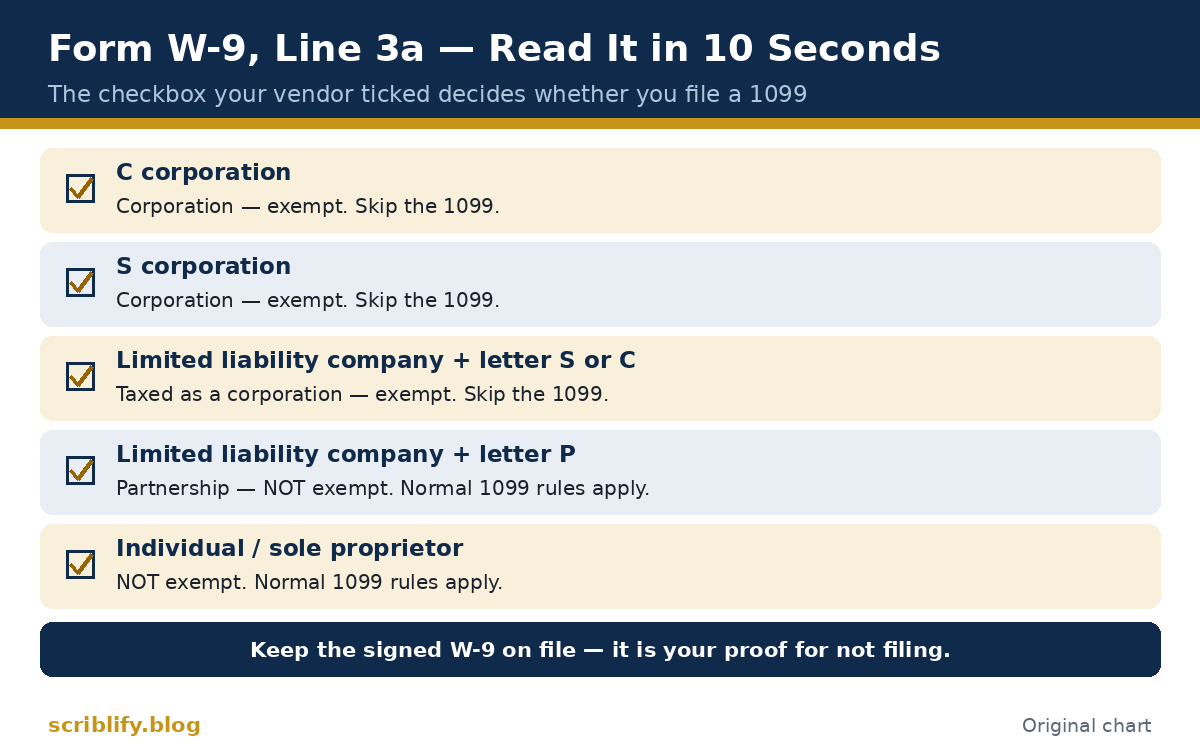
A corporation lists its EIN as the tax ID and uses exempt payee code 5, which also makes it generally exempt from backup withholding. Keep the signed W-9 — if the IRS ever asks why no 1099 was filed for that vendor, this form is your answer.
One mix-up that does not hurt you: an S corp that checks the “C corporation” box by mistake. C and S are both exempt, so no duty appears. The error that matters is a payee that is not a corporation at all claiming to be one — which is why you collect the form instead of accepting a verbal “we’re incorporated.”
Elected S status recently? Send your clients a fresh W-9 with the S corporation box checked — it stops 1099s arriving in your old sole-proprietor name.
The IRS version, in plain English: Am I Required to File a Form 1099 or Other Information Return?
What If the Vendor Is an LLC?
An LLC’s name tells you nothing. Its tax classification tells you everything.
An LLC is a legal shell, not a tax status. For 1099 purposes it lands in one of three places:
- Taxed as an S corp or C corp → exempt, like any corporation. Ignore claims that an LLC taxed as an S corp “should expect 1099s over $600” — that is simply wrong; the exemption covers it.
- Taxed as a partnership (the multi-member default) or disregarded (the single-member default) → not a corporation. Pay it $2,000 or more for services in 2026 and you file Form 1099-NEC, Box 1.
Status can change, too — an LLC can elect corporate taxation along the way, which moves it into the exempt column. The safe habit: collect a fresh W-9 when you onboard a vendor, and ask for an updated one if its status changes.
A single-member LLC is a disregarded entity unless it elects corporate tax — our guide explains what that means for its taxes.
Received a 1099 Your S Corp Should Not Have? Do This
First, check whether it is actually wrong: a form covering attorney fees or medical payments may be a real exception — check the matrix before you object.
If a client sent your S corp a 1099-NEC for ordinary services, it was filed in error. Work through these steps:
- Tell the payer, in writing: send your Form W-9 showing the S corporation classification and ask for a corrected return that zeroes out the amounts.
- Keep proof that you asked — an email thread is fine, dates included.
- If the payer will not fix it, file your taxes the right way anyway: report your actual income on Form 1120-S, and keep the 1099, your W-9, and your messages in one file. If the IRS matches documents and asks, that paper trail is your explanation.
Sent One to a Corporation by Mistake? The Payer’s Fix
File a corrected return with the amounts set to zero, following the IRS general instructions for information returns, and send the corporation a copy. Fixing it yourself beats waiting for a complaint — a wrong form on file is how mismatched income notices start.
What Does It Cost to Get It Wrong?
Filing a required 1099 late — or not at all — costs per form (for 2026 payments, filed in 2027):
- Fixed within 30 days: $60 per form
- Fixed by August 1: $130 per form
- After August 1, or never filed: $340 per form
- Intentional disregard: $680 per form, with no cap
Yearly maximums cap the total per business, and a separate set of penalties applies to the copy you owe the worker.
The flip side is calmer: there is no penalty for skipping a form the rules never asked for. When the matrix says skip, skipping is correct — filing “just to be safe” only creates cleanup work when a form lands in the corporation’s mailbox that should not exist.
Key Takeaways
- S corps, C corps, and LLCs taxed as either are exempt from 1099-NEC and 1099-MISC reporting.
- The exceptions are short: attorney fees, medical payments, attorney settlement proceeds, cash fish purchases, and substitute payments.
- For 2026, the main threshold is $2,000 per payee, not $600. Boxes 10 and 11 still start at $600, and Box 8 starts at $10.
- Rent and royalties paid to a corporation are never reported.
- Form W-9, line 3a, is the deciding document. Collect it before you pay, and keep it on file.
- A 1099 sent to a corporation by mistake is fixed with a corrected, zeroed return.
FAQs
Do S corps receive 1099s?
Generally, no. The IRS exempts payments to corporations — S corps, C corps, and LLCs taxed as either — from both Form 1099-NEC and Form 1099-MISC. A client paying your S corp for normal services should not send one, whatever the amount. Only named exceptions — attorney fees, medical payments — still get reported.
Does an S corp ever receive a 1099-NEC?
Yes, in a narrow case: attorney fees. If a business pays an S-corp law firm $2,000 or more for legal services in 2026, it files Form 1099-NEC, Box 1. Payments by federal executive agencies for services to corporations count too. Every other S corp service stays exempt.
Do C corps get a 1099?
No, not for ordinary payments. A C corporation sits under the same exemption as an S corporation, so services, rent, and royalties paid to it are not reported. The same exceptions apply: attorney fees, medical payments, settlement proceeds paid to an attorney, cash fish purchases, and substitute payments are still filed.
What if a client mistakenly sends a 1099 to my S corp?
Send the client your Form W-9 showing the S corporation classification and ask for a corrected, zeroed return. If they refuse, report your actual income on Form 1120-S anyway, and keep the form, your W-9, and your emails — that paper trail answers any IRS matching notice.
Are credit card payments to an S corp reportable?
Not by you. When a client pays by card or through a third-party network, the processor reports it on Form 1099-K. The payer never files a 1099-NEC or 1099-MISC for card payments. For 2026 the 1099-K threshold is back to more than $20,000 paid across more than 200 transactions.
I don’t have a W-9 from the S corp. Should I send a 1099 anyway?
Get the W-9 first — it is your only proof the payee really is a corporation. Ask before you pay — a corporation checks the S or C box on line 3a and uses exempt payee code 5. Filing just to be safe creates a wrong form the recipient then has to unwind.
Does an LLC taxed as an S corp get a 1099?
No. For 1099 rules, what matters is the tax classification, not the legal name. An LLC that elects S corporation taxation is treated as a corporation, so its clients skip the 1099 under the corporate exemption. Confirm it on the vendor’s W-9: LLC box checked, letter S written beside it.
What is the 1099 reporting threshold in 2026?
For most payments, $2,000 per payee for the year — the One Big Beautiful Bill Act raised it from $600 for payments after December 31, 2025. Three limits did not change: settlement proceeds and cash fish purchases start at $600, and substitute payments at $10. From 2027, the $2,000 figure adjusts for inflation.
I own an S corp — do I get a 1099 or a W-2?
A W-2. If you work in your own S corp, you are its employee: the corporation must pay you a reasonable salary, withhold tax, and send you a W-2. The corporation never sends its owner a 1099 for that work. Money you take beyond salary comes out as a distribution, which is also not reported on a 1099. That salary runs through payroll, with tax withheld like any employee’s pay.
Is an S corp exempt from self-employment tax?
The corporation pays no self-employment tax. Shareholders who work in the business are employees: their salary goes on a W-2 and carries Social Security and Medicare tax (FICA). Profit taken as distributions, after a reasonable salary, is not hit by self-employment tax or FICA — that split is the main tax saving of an S corp.
If Your S Corp Hires Contractors
The rules flip when your S corp is the payer. Collect a W-9 from every contractor before you pay. If you pay $2,000 or more for services in 2026, send a 1099-NEC by February 1, 2027. Paying a corporation? Usually no form — the same exemptions in this article apply to you as the payer.
Conclusion
The rule is simpler than the rumors: corporations are exempt, a short list of payments is not, and for 2026 the number is $2,000. Run your payment through the matrix, keep the W-9 on file, and January gets much quieter.
Working through a full season of forms? Our complete 1099 and contractor guide covers deadlines, copies, and e-filing for the whole family — and when a payment fits no row of the table, a CPA is worth the call.
This guide is educational and is not tax advice.
Leave a Reply