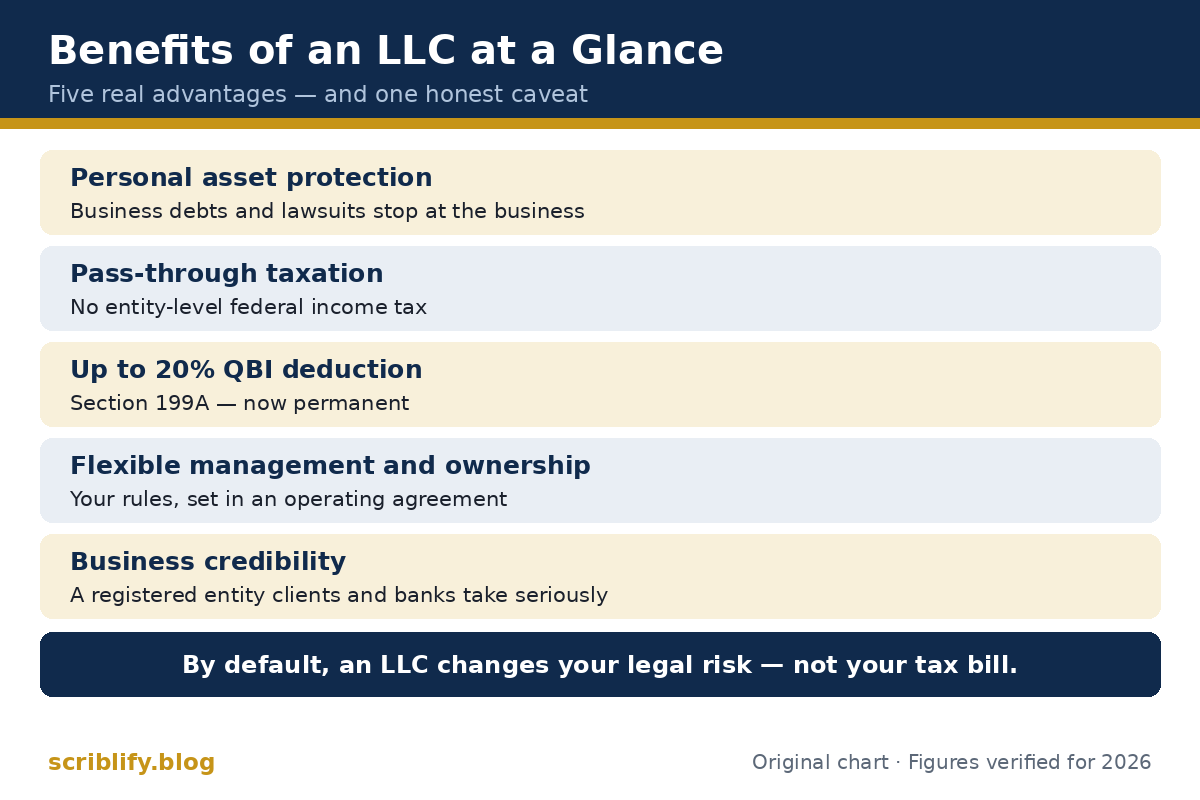
Quick Answer: The main benefits of LLC formation are personal asset protection, pass-through taxation with no entity-level federal tax, a possible 20% deduction on qualified business income, and flexible management. The honest catch: a basic LLC does not cut your tax bill — by default it is taxed exactly like a sole proprietorship.
An LLC can protect your house, your savings, and your car from business debts. That part is real.
But some of the advantages of an LLC get oversold. The biggest myth in small business is that forming an LLC automatically lowers your taxes. It does not — and this guide will show you the exact dollar math.
Below, you will find every real benefit, what each one actually requires, and what it does not do. Everything here is checked for 2026, including the tax-law changes most guides have not caught up with yet.
If you want the full tax picture after this, our complete LLC taxes guide covers rates, forms, and deadlines in depth.
What is an LLC, in plain English?
An LLC (limited liability company) is a business structure you create under state law. It sits between you and your business as a legal wall.
That wall is the whole point. Your business can earn money, sign contracts, and owe debts — while you, the owner, stay personally separate from most of those obligations.
An LLC is not a tax status by itself. It is a legal shell, and the IRS taxes whatever is inside it using default rules (or an election you file). Keeping that distinction clear makes every “benefit” below easier to judge.
The IRS explains these default rules on its Limited Liability Company (LLC) page.
What is the main benefit of an LLC?
Personal liability protection. If your business is sued or cannot pay its debts, creditors can generally go after business assets — not your personal ones.
Say your business owes a supplier $40,000 it cannot pay. As a sole proprietor, that debt is your debt. As an LLC owner, it normally stops at the business.
This shield is the primary reason most owners form an LLC, and it is a genuine benefit. But it has edges you need to know:
- Your own wrongdoing is not covered. If you personally cause the harm — your own negligence or malpractice — the LLC does not protect you from that.
- Personal guarantees pierce it. Sign a loan or lease as a personal guarantor, and you owe the money yourself, LLC or not.
- Mixed money weakens it. Run personal and business cash through one account, and a court may ignore the LLC entirely (called piercing the veil). A separate business bank account is not optional — it is what keeps the shield real.
One more nuance most guides skip: in a multi-member LLC, many states limit a member’s personal creditor to a “charging order” — they can collect distributions, but cannot seize the business itself. That extra layer is weaker for single-member LLCs in some states, such as Florida.
Does an LLC save you money on taxes?
By default, no — the tax saving is $0. This is the fact the rest of the internet buries, so here it is plainly. That default has a name: a one-owner LLC is a disregarded entity, and our guide explains exactly how the IRS taxes it.
The IRS does not tax “an LLC” as its own thing. By default:
- A single-member LLC is a disregarded entity — taxed exactly like a sole proprietorship. Profit lands on your personal return, and you pay self-employment tax on it.
- An LLC with two or more members is taxed as a partnership — it files Form 1065, and each owner reports their share on a Schedule K-1.
- Either way, there is no entity-level federal income tax. The profit passes straight through to the owners. That pass-through treatment is a real benefit compared with a C corporation’s two layers of tax — but a sole proprietor gets the same single layer without forming anything.
So where do the famous tax benefits come from? Two places — and neither is automatic. When you are ready to take money out, our owner draw guide explains how draws work, when to take them, and how they are taxed.
The 20% qualified business income (QBI) deduction
Eligible owners can deduct up to 20% of qualified business income under Section 199A. On $100,000 of qualifying profit, that is up to $20,000 of income the IRS does not tax.
Three things most guides get wrong about it:
- Sole proprietors can claim it too. It is not an LLC-only perk.
- It is now permanent. Older guides say the deduction expires after 2025. That sunset was removed by the One Big Beautiful Bill Act (Public Law 119-21), and from 2026 there is a new $400 minimum deduction if you have at least $1,000 of QBI from an active business you materially participate in.
- It has caps. The deduction is generally limited to 20% of your taxable income minus net capital gains, and extra wage/property limits and industry restrictions kick in above income thresholds. For 2026, these income limits start at taxable income of $201,750 for single filers and $403,500 for married couples filing jointly; above those levels, extra limits phase in.
An election, if the math favors it
An LLC can choose to be taxed as an S corporation (Form 2553) or a C corporation (Form 8832). That choice — not the LLC itself — is where real employment-tax savings can appear. The next section shows exactly how, in dollars.
How much tax do you actually pay on $100,000 of profit?
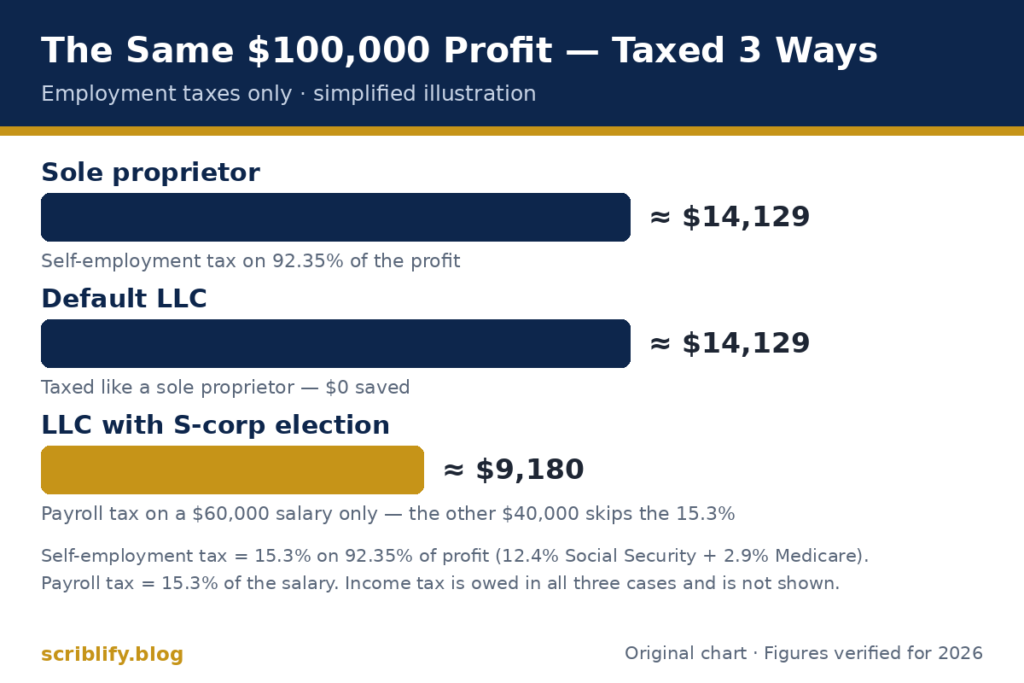
Here is the same $100,000 of business profit, taxed three ways. Employment taxes only; self-employment tax is 15.3% on 92.35% of profit; payroll tax is 15.3% of the salary. Simplified illustration — income tax is owed in all three cases and is not shown.
| Setup | How the $100,000 is taxed | Employment tax |
|---|---|---|
| Sole proprietor | Self-employment tax on the full profit | ≈ $14,129 |
| Default LLC (single-member) | Ignored by the IRS — taxed like a sole proprietor | ≈ $14,129 |
| LLC electing S-corp tax status | $60,000 salary + $40,000 distribution | ≈ $9,180 |
Read the first two rows again. Identical. Forming the LLC changed the owner’s legal risk and changed his tax bill by zero dollars.
The third row is the one real tax lever. With an S-corp election, payroll tax (the same 15.3%) applies only to the $60,000 salary: $9,180. The remaining $40,000 passes through as a distribution with no self-employment or payroll tax on it — roughly $4,949 less in employment taxes on the same profit.
Two honest warnings about row three:
- The saving is not a lower income-tax rate. The money you take out is not taxed a second time as a distribution — you already pay income tax on the profit in the year the business earns it.
- The election adds work: payroll to run, and a separate corporate return to file. At lower profits, those costs can eat the whole saving. This is a “run the numbers first” decision — and our LLC vs corporation comparison walks through the full trade-off.
How do LLC owners get paid?
Owners do not get a paycheck from their own LLC by default. A single-member owner takes an owner’s draw; partners take draws or guaranteed payments; an LLC taxed as an S corporation pays its owners a salary through payroll. Our owner draw guide explains each method in full. For every method side by side on one worked example, see how to pay yourself from an LLC.
The Benefit Reality Check
Most “benefits” lists tell you what an LLC gives you. This table tells you what each advantage of LLC ownership actually takes — and where it stops.
| Benefit | True by default? | What you must do to get or keep it | What it does NOT do |
|---|---|---|---|
| Liability shield | Yes, once you form properly | Keep business and personal money separate; avoid personal guarantees | Does not cover your own negligence or debts you personally guarantee |
| Lower taxes | No | Elect S-corp (Form 2553) or C-corp (Form 8832) treatment, if the math fits | A default LLC is taxed like a sole proprietorship or partnership — $0 saved |
| 20% QBI deduction | Available, not automatic | Have qualified business income; watch the income caps | Sole proprietors qualify too — it is not an LLC-only perk |
| Flexible management | Yes | Write an operating agreement that matches how you really run the business | Does not settle disputes between members by itself |
| Credibility | Mostly | Use the LLC name on contracts and invoices; stay in good standing with your state | Does not replace a track record, reviews, or good work |
What other practical benefits does an LLC give you?
Beyond protection and taxes, owners point to three quieter advantages:
- Flexibility. You choose how the LLC is managed (by the members, or by appointed managers), how profits are split, and who owns what — all set in your operating agreement rather than by rigid corporate rules.
- It can last indefinitely. Perpetual duration is the default in most states. The business does not automatically dissolve when a member leaves; the operating agreement handles the change.
- A more serious front door. “LLC” after your business name signals to clients, landlords, and banks that you are a registered, operating business — a small but real credibility edge over an unregistered sole proprietor.
How do you form an LLC to get these benefits?
Getting these benefits takes five steps, and most states let you do all of them online:
- Choose a name. It must be different from other businesses in your state, and it must include “LLC” or “Limited Liability Company.”
- Pick a registered agent. This is the person or company that receives legal papers for the LLC — it can be you (as long as you have a street address in the state and can be reached there during business hours).
- File Articles of Organization with your state. This is the form that officially creates the LLC. The fee depends on the state — Illinois charges $150, for example.
- Write an operating agreement. Not always required by the state, but it proves the LLC is separate from you — and that separation is what keeps your liability protection real.
- Get an EIN if you need one. It is free from the IRS. You must have one if the LLC has employees or more than one member — and most banks ask for one before they open a business account.
How much does an LLC cost?
State filing fees to form an LLC depend on the state. Illinois, for example, charges $150 to file Articles of Organization — beware older guides still quoting $500.
The bill does not end at filing:
- California charges LLCs an $800 annual tax, every year.
- Many states require an annual report (with a fee) and a registered agent.
- New York adds a newspaper publication requirement after formation.
One chore has disappeared: a 2025 FinCEN rule change exempted domestic companies from federal beneficial ownership (BOI) reporting. If a guide tells you to file a BOI report for your US-formed LLC, it is out of date.
What are the biggest LLC myths?
- “An LLC protects me from everything.” No. Your own negligence, your professional malpractice, and anything you personally guarantee sit outside the shield.
- “A DBA protects my assets.” A DBA (“doing business as”) is only a name registration. It creates no legal wall at all.
- “An LLC means I stop paying tax.” Pass-through taxation means the tax passes to you. The IRS still gets paid — by you, personally.
- “Form in Delaware or Wyoming to save tax.” If your business actually operates in your home state, you generally must register there too (foreign qualification) — which usually wipes out the supposed saving.
Who should NOT form an LLC?
An LLC is a tool, not a ritual. It is probably not worth it yet if:
- Your income from the activity is hobby-level and your real-world risk is near zero.
- You are building a startup that plans to raise venture capital — investors strongly prefer corporations.
- You are a licensed professional in a state that requires a PLLC instead — check your state’s rule for your profession first.
- Your main risk is the kind insurance covers. Sometimes a good liability policy is the protection you actually need, with or without an entity.
If two or three of the benefit sections above describe your situation — real liability risk, growing profit, plans to hire or sign contracts — the LLC usually earns its keep. If you are unsure, a one-hour review with a CPA before you file is money well spent.
Key Takeaways
- The #1 benefit of an LLC is liability protection: business debts normally stop at the business.
- By default, an LLC saves $0 in tax versus a sole proprietorship — it is taxed the same way.
- The 20% QBI deduction is real, permanent, and available to sole proprietors too.
- Real tax savings come from an election (usually S-corp status), not from the LLC itself — on $100,000 of profit, the right election can cut employment tax by roughly $4,949.
- The shield has conditions: separate your money, and never assume it covers your own mistakes or guaranteed debts.
- Formation fees depend on the state (Illinois charges $150), plus yearly costs like California’s $800 LLC tax.
Frequently Asked Questions
What is the primary benefit of forming an LLC?
Personal liability protection. The LLC separates your business from your personal assets, so business debts and lawsuits normally cannot reach your house, car, or savings. The protection holds only if you keep business and personal money separate and do not personally guarantee business debts.
How is an LLC taxed by default?
A single-member LLC is taxed like a sole proprietorship — the IRS ignores the LLC and the profit goes on your personal return. An LLC with two or more members is taxed as a partnership, filing Form 1065 with a K-1 for each owner. Either way, there is no entity-level federal income tax.
Does an LLC really save you money on taxes?
Not by default. A basic LLC is taxed identically to a sole proprietorship or partnership, so the saving is $0. Savings appear only when the LLC elects S-corporation taxation and the profit is high enough that paying payroll tax on a salary alone beats paying self-employment tax on everything.
Is the 20% QBI deduction ending?
No. Older articles say the Section 199A deduction expires after 2025, but the One Big Beautiful Bill Act made it permanent. From 2026, there is also a $400 minimum deduction if you have at least $1,000 of qualified business income from an active business you materially participate in. Income-based caps still apply.
How much does it cost to form an LLC?
It depends on the state. Illinois charges $150, for example. After that, most states charge something yearly — an annual report fee, and in California an $800 annual LLC tax. Budget for the yearly costs, not just the filing fee, when you judge whether an LLC is worth it.
Do I need an EIN for a single-member LLC?
Not for federal income tax, if you have no employees and no excise-tax filings — as a disregarded entity you can use your own Social Security number. In practice, many owners still get an EIN because banks often ask for one, and you will need one if you elect corporate tax treatment.
Does an LLC protect me from my own mistakes?
No. The shield covers business obligations, not your own actions. If your own negligence or professional malpractice causes the harm, or you signed a personal guarantee on a loan or lease, you can still be personally responsible. Insurance, not the LLC, is the tool for your own-mistake risk.
What is the difference between an LLC and a sole proprietorship?
Legally, a lot; on taxes, almost nothing by default. An LLC is a registered state entity that shields your personal assets from business debts. A sole proprietorship has no shield at all. For federal income tax, a single-member LLC and a sole proprietorship are treated exactly the same way.
What happens if an LLC makes no money?
Nothing dramatic. With no profit, there is no income tax on the business — and a real loss can often lower the tax on your other income, subject to IRS limits. But the LLC still exists on paper: state annual reports and fees still apply, and California’s $800 annual tax is due even in a year with no income.
What taxes can you write off with an LLC?
The same business expenses any other business can write off — an LLC gets no special list. If a cost is ordinary and necessary for your business — supplies, software, rent, advertising, professional fees — it is generally deductible, and a single-member LLC claims the expenses on Schedule C, just like a sole proprietor. Our guide to small business tax deductions lists the main categories and the rules for each.
What are the disadvantages of an LLC?
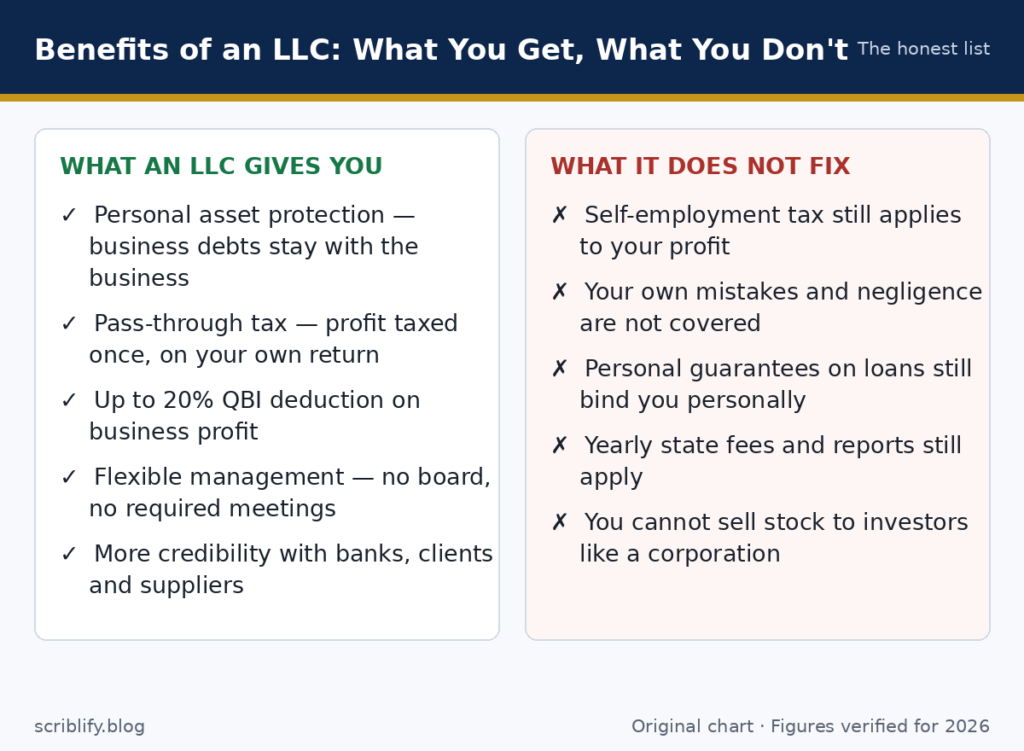
The main ones: you still pay self-employment tax on your profit; forming and yearly state fees cost money; raising money from investors is harder because you cannot sell stock; some lenders still ask for a personal guarantee; and the paperwork, while light, never fully stops — annual reports and separate accounts are on you.
Conclusion
The benefits of an LLC are real — but they are specific. You get a legal shield for your personal assets, flexible ownership and management, and access to tax elections that can save serious money once your profit is high enough.
What you do not get is an automatic tax cut. Go in knowing that, keep your finances separate, and the LLC will do the job it is actually built for.
Ready to take the next step? Start with the full picture in our LLC taxes guide, then compare structures in our LLC vs corporation guide before you file anything.
This guide is educational and is not tax advice.
Leave a Reply