Quick Answer
What is a tax write off? It is a business expense you subtract from your income before tax is worked out. It is simply the everyday word for a tax deduction. It is not free money: a $1,000 write-off takes $1,000 off the income you are taxed on, not $1,000 off your tax bill. Only ordinary and necessary business expenses count. A quick way to feel it: a $100 write-off at a 24% tax rate saves you about $24 — the expense cuts your taxable income; it does not come back as cash.
Introduction
You have probably heard someone say, “Buy it — you can write it off.” It sounds like the tax system pays for your purchase. It does not, and believing that costs new business owners real money.
This guide explains, in plain words, what a write-off is, how much one is actually worth, what counts, and what does not — with real numbers, not guesses.
What is a tax write off?
It means you deduct the expense. When you write off a business cost, you subtract it from your business income, so the IRS taxes only what is left.
Write-off is everyday slang, not a legal term. On tax forms, the IRS calls it a deduction.
Most business write-offs rest on one rule: Section 162 of the tax code, which lets you deduct expenses that are ordinary and necessary in your line of work. So the meaning of a tax write-off is simple: money the business genuinely needed to spend, taken off your income before the tax is figured.
‘Write-off’ has a second meaning: a lender cancelling a debt. That is a different topic — and cancelled debt can itself be taxed as income.
How does a tax write-off save you money?
A write-off saves money by shrinking the income the IRS taxes. You keep your tax rate’s share of every dollar you deduct — not the whole dollar.
Here is the math on a simple example:
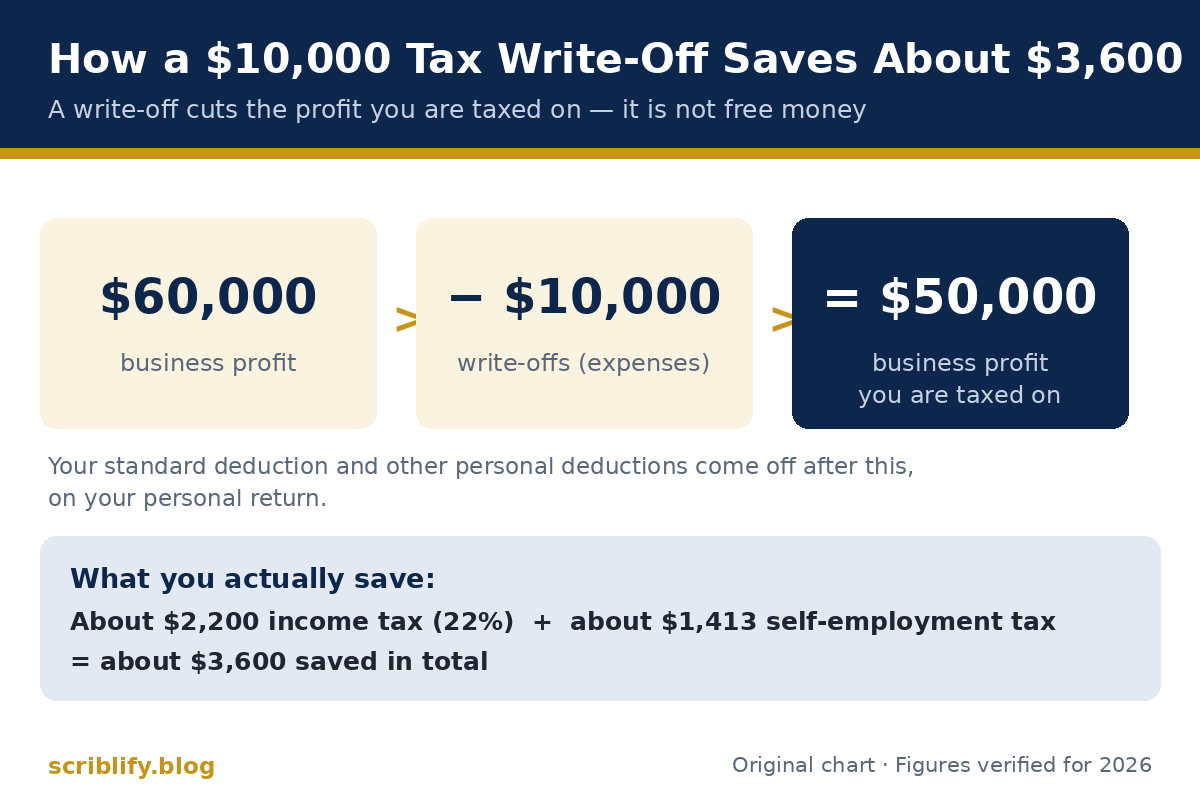
- Business profit for the year: $60,000
- Real business expenses you write off: $10,000
- Business profit you are taxed on: $50,000 (your standard deduction comes off later, on your personal return)
At a 22% income tax rate, being taxed on $10,000 less saves about $2,200 in income tax. Because Schedule C expenses also reduce self-employment tax, the same write-offs save roughly another $1,413 there.
Total saving: about $3,600. That is real money — and it also shows why the “free money” version of the story is wrong. The $10,000 did not come back. Just over a third of it did.
Rule of thumb: one dollar of write-off is worth roughly your tax rate — about 22¢ in the 22% bracket — plus the self-employment saving if you work for yourself. Those savings matter most at draw time — our owner draw guide shows how self-employment tax follows your profit, whatever you take out.
Write-off vs deduction vs tax credit: what is the difference?
A write-off and a deduction are the same thing. A tax credit is different — and stronger — because it cuts your tax bill itself, dollar for dollar.
| What it lowers | What $1,000 of it saves you (at a 22% tax rate) | |
|---|---|---|
| Tax write-off | The income you are taxed on | About $220 off your tax |
| Tax deduction | The income you are taxed on | About $220 off your tax |
| Tax credit | Your tax bill directly | The full $1,000 off your tax |
That is the whole write-off vs tax credit difference: a write-off makes the taxed income smaller; a credit makes the final bill smaller.
Self-employed filers get one bonus the table hides: every $1,000 you write off also saves roughly $141 in self-employment tax, on top of the $220.
What counts as a small business tax write-off?
A cost counts if it passes the IRS’s two-word test: it must be ordinary and necessary.
Ordinary means common and accepted in your industry — the kind of cost businesses like yours normally have.
Necessary means helpful and appropriate for your business. It does not have to be essential. If it genuinely helps you do the work, it usually passes.
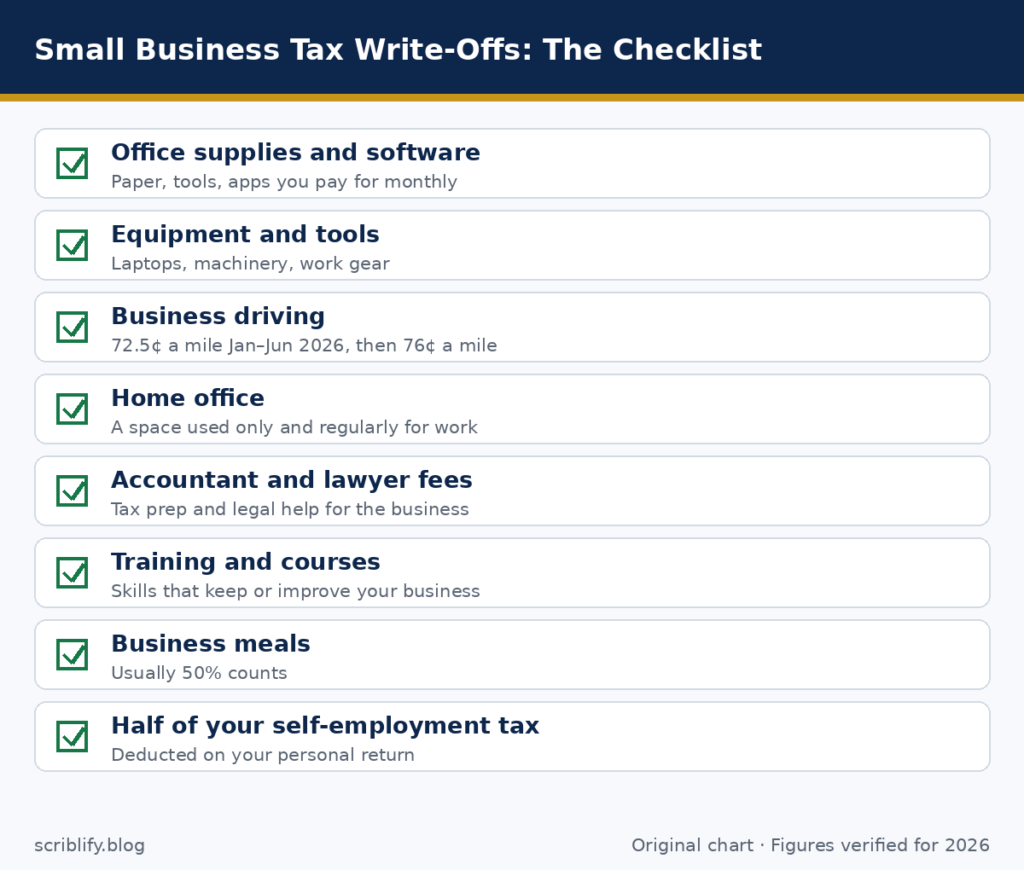
Small business tax write-offs that commonly pass the test:
- Office supplies and software your business runs on
- Equipment and tools for the work
- Business driving: 72.5 cents per mile for January to June 2026, and 76 cents per mile from July 1, 2026, at the standard mileage rate, or your actual costs
- A home office set aside and used only for work
- Fees for your accountant or lawyer
- Training and courses that keep your work skills current
- Business meals — usually only 50% of the cost counts
- Half of your self-employment tax, which is itself a deduction (You claim that deduction on your personal Form 1040 — not on Schedule C.)
One advantage worth knowing: business write-offs come off your profit first, and you still claim the standard deduction on top — $16,100 for a single filer in 2026. The two stack; they do not compete.
What If You Are Not Self-Employed?
Personal write-offs work differently: most people take the standard deduction ($16,100 if single, $32,200 if married filing jointly, and $24,150 for head of household, for 2026). Itemizing only wins if your personal deductions — like mortgage interest, charitable gifts, and medical costs above 7.5% of your income — add up to more. Our small business tax deductions guide covers the business list in full.
That is just the short list. Our complete guide to small business tax deductions goes through the categories in detail, with the current numbers.
What can you NOT write off?
Anything personal — and anything that fails the ordinary and necessary test, no matter how business-like it feels. The usual traps:
- Commuting. The drive from home to your regular workplace is personal travel in the IRS’s eyes, however long it takes.
- Everyday clothing. Clothes you could wear outside work are a personal cost, even if you only ever wear them on the job.
- Entertainment. Tickets, games and shows for clients have not been deductible since the Tax Cuts and Jobs Act. Business meals are a different story — entertainment is zero.
- Gym memberships. Staying fit may help your work, but the IRS treats it as personal.
- Anything you would have bought anyway. If the business did not need it, it is not a write-off.
Partly business, partly personal? Then only the business share counts. A phone used 70% for work is a 70% write-off — keep a rough log or a sensible estimate to support the split.
Should you buy something just for the write-off?
No — never buy something only for the tax saving. The math does not work.
A write-off saves you roughly your income tax rate on each dollar spent — at a 22% rate, about 22 cents — and self-employed owners save up to about 14 cents more per dollar in self-employment tax, on profit under the Social Security wage limit. Spend a dollar purely for the write-off and you are still about 63 to 78 cents worse off.
It is the same with bigger buys. A $1,000 laptop still leaves about $640 to $780 coming out of your own pocket after the tax saving.
The smart version: if the business needs it anyway, buying before year-end pulls the saving into this year’s return. If you would not buy it without the write-off, walk away.
Is a Write-Off Good or Bad?
Good, when the expense was worth buying anyway — then the tax saving is a discount on something you needed. Bad, when you spend a dollar only to save about 25 cents of tax: you are still out the other 75 cents.
How do you claim a write-off?
You claim write-offs on your tax return. For most small business owners, that means listing your expenses on Schedule C — there is no separate form to file in advance.
- Spend, and save the proof. Every time you pay for something for the business, keep the receipt or statement: the amount, the date, and what it was for.
- Sort expenses into categories as you go — software, mileage, supplies — so tax time takes minutes, not a weekend of digging.
- Enter the totals on Schedule C. They come straight off your business income, cutting both your income tax and your self-employment tax.
- Keep the records with your return. If the IRS ever questions an expense, the receipt is your answer.
The IRS explains the official rules in its guide to deducting business expenses. Good records make claiming simple — our bookkeeping basics guide covers the monthly habits.
Key Takeaways
- A tax write-off is just a deduction: a business expense subtracted from your income before tax is calculated.
- It never pays you back in full. You save roughly your income tax rate on each dollar spent — at a 22% rate, about 22 cents — and self-employed owners save up to about 14 cents more per dollar in self-employment tax, on profit under the Social Security wage limit.
- The expense must be ordinary (common in your industry) and necessary (helpful and appropriate).
- Self-employed owners save twice: write-offs cut income tax and self-employment tax.
- A credit beats a deduction dollar for dollar: a $1,000 credit saves $1,000; a $1,000 write-off saves about $220 at the 22% rate.
- Keep a record of every expense: amount, date, and what it was for.
Frequently Asked Questions
Is a tax write-off the same as a deduction?
Yes. Write-off is the word people use in conversation; deduction is the word the IRS uses in the tax code and on its forms. They mean exactly the same thing: a business expense subtracted from your income before tax is calculated, so you pay tax on a smaller amount of money.
Do you get the full amount of a write-off back?
No. A write-off lowers the income you are taxed on, not the tax itself. A $1,000 write-off in the 22% bracket saves about $220 — not $1,000. If you are self-employed, it also cuts self-employment tax, adding roughly another $141 of savings on that same $1,000 of expenses.
Can a W-2 employee write off work expenses?
No — not under current law. Employees cannot deduct unreimbursed work expenses in 2026 — that deduction was suspended in 2018 and has not come back. One small exception: teachers can deduct up to $350 of classroom supplies for 2026 — and from 2026, spending above that amount can also be deducted if they itemize, with no cap. Tax write-offs are for business owners and the self-employed, who report business income and subtract their business costs from it.
What records do I need to keep for a write-off?
Keep proof for every expense: a receipt, invoice, or bank or card statement showing how much you paid, when, and what it was for. A short note on the business purpose helps too. Store them with your tax records — if the IRS questions a deduction, the paperwork is your protection. For driving, a simple mileage log — date, miles, and where you went and why — is the record the IRS wants.
Can I write off my car?
Only the business part. You can deduct business miles — at 72.5 cents per mile for January to June 2026, and 76 cents per mile from July 1, 2026, using the standard mileage rate — or the business share of actual costs like fuel and repairs. Driving from home to your regular workplace is commuting, and commuting never counts, however far it is. Pick one method — standard mileage or actual costs — never both for the same car in the same year. And driving from home to a regular workplace is commuting, which is never deductible.
Does claiming a big write-off trigger an audit?
Not by itself. Honest write-offs with records to back them up are a normal part of running a business, and the IRS expects them. The real risk is claiming expenses you cannot prove, mixing personal spending into the business, or deducting things that fail the ordinary and necessary test.
Is a laptop a 100% write-off?
Only the part you use for business. If a laptop is used 80% for work and 20% for personal things, you can write off 80% of its cost. Section 179 may let you deduct that business cost in the year you buy it instead of spreading it over several years.
How much do I get back from a write-off?
Nothing comes back as a refund. A write-off lowers the income you are taxed on, so you save your tax rate on that amount — a $1,000 write-off at a 22% rate saves about $220, plus self-employment tax savings if you are self-employed.
What are the new tax write-offs for 2026?
Four new deductions began under the One Big Beautiful Bill, and none needs itemizing: qualified tips up to $25,000; the overtime premium up to $12,500 ($25,000 joint); up to $10,000 of interest on a loan for a new, US-assembled car; and an extra $6,000 for each person aged 65 or over. Income limits apply; all four run through 2028.
Conclusion
Short version: a write-off is a real saving, just a smaller one than the hype suggests. Every legitimate business expense you track and claim takes money off your tax bill — roughly your tax rate on every dollar, plus a self-employment tax saving on top.
Ready to find yours? Our complete guide to small business tax deductions lists what small businesses can claim, category by category. And if your taxes are getting complicated, a good CPA can spot write-offs you would have missed.
This guide is educational and is not tax advice.